
Does Directory Submission Still Work for SEO in 2026?
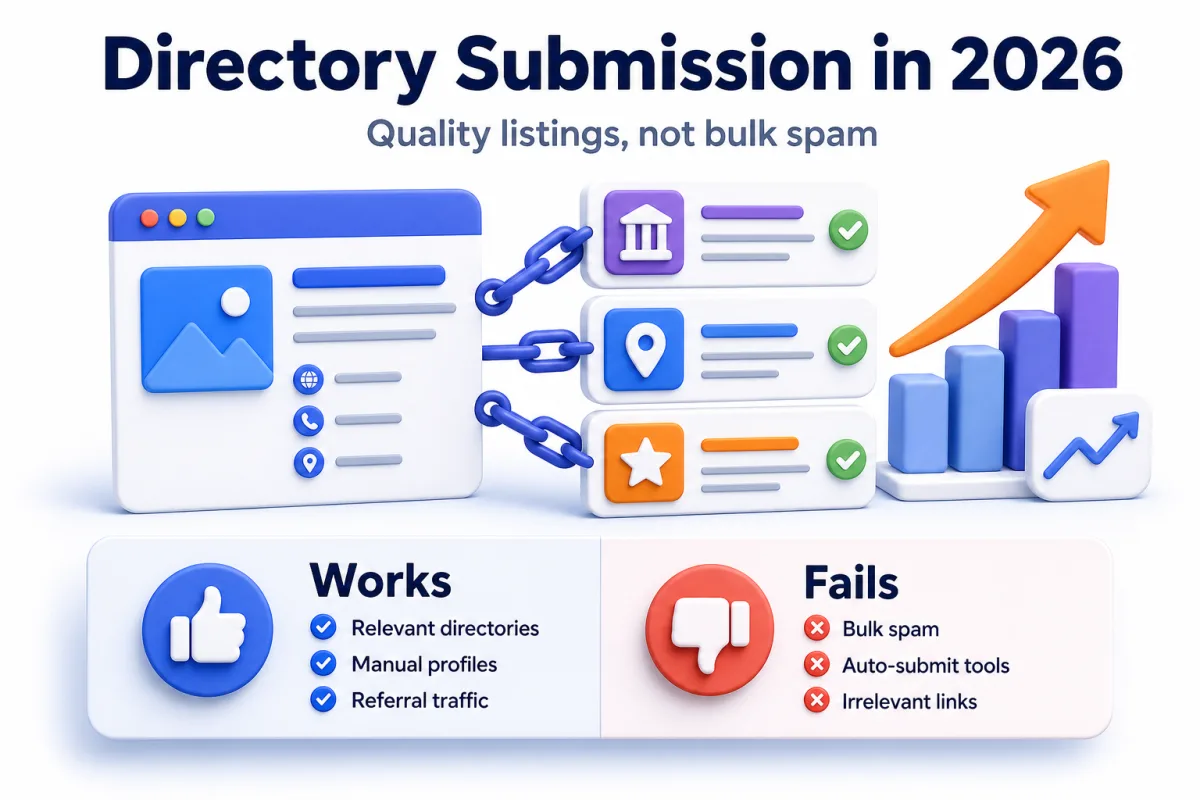
Directory submission is one of the most misunderstood SEO tactics. Some people still treat it like a bulk link-building shortcut. Others dismiss it completely because old-school directory spam stopped working years ago. The useful answer sits in the middle: directory submission can still help in 2026, but only when the listings are relevant, selective, and built for real discovery.
In this guide
- 1.Quick Answer
- 2.Why Directory Submission Got a Bad Reputation
- 3.What Changed in 2026
- 4.When Directory Submission Still Helps
- 5.When Directory Submission Does Not Help
- 6.What Makes a Directory Worth Submitting To
- 7.Manual vs Automated Directory Submission
- 8.Can Directory Submission Increase Domain Rating?
- 9.Can Directory Listings Help AI Search Visibility?
- 10.A Safe Directory Submission Workflow
- 11.Final Verdict
Quick Answer
Yes, directory submission still works for SEO in 2026, but not in the old "submit everywhere" way.
Directory submission helps when you list your website on relevant, real, moderated platforms that people or search engines can actually trust. For startups, SaaS products, AI tools, developer tools, local businesses, and new websites, good directory profiles can create early backlinks, brand mentions, referral traffic, and external trust signals.
Directory submission does not work when it is automated across hundreds of thin, unrelated, low-quality directories created only for link manipulation. That approach can waste time, create messy backlinks, and conflict with Google's spam policies around low-quality directory links and automated link creation.
Why Directory Submission Got a Bad Reputation
Directory submission used to be treated like a quantity game. SEO agencies would submit the same website to thousands of generic directories with spun descriptions, keyword-heavy anchor text, and no concern for relevance.
That version of directory submission deserves its bad reputation.
The problem was not the idea of being listed on another website. The problem was the pattern:
- Irrelevant directories
- Duplicate descriptions everywhere
- Automated submissions
- No editorial review
- No real users
- Keyword-stuffed anchors
- Thin pages created only to pass link value
Search engines became better at discounting those patterns. Today, the value comes from quality, relevance, and proof that the listing exists in a real discovery context.
What Changed in 2026
In 2026, directory submission is less about link count and more about building an external footprint.
A new startup website often has no branded search demand, no mentions, no backlinks, no review profiles, and no third-party pages explaining what the product does. That creates a discovery problem for users, search engines, and AI systems.
Good directories can help fill that gap because they create structured external profiles. A listing usually includes your product name, URL, category, description, logo, and sometimes screenshots, pricing, social links, and founder details.
That information can support:
- Brand discovery
- Referral traffic
- Backlink diversity
- Search engine crawling
- Consistent product descriptions
- AI-readable context across the web
- Trust signals outside your own homepage
When Directory Submission Still Helps
Directory submission is most useful when your site is new or under-discovered.
It can help if:
- Your website has very few backlinks
- Your Domain Rating is low or close to zero
- Your startup is not showing up for branded searches yet
- Your product needs early visibility outside social media
- You want referral traffic from startup and SaaS discovery platforms
- You need external pages that describe your product consistently
- You are building a safer backlink foundation before publishing more content
For a new SaaS or AI tool, directory submission is often a practical first SEO layer. It will not replace content, technical SEO, or product-led growth, but it can help search engines and users discover that the product exists.
When Directory Submission Does Not Help
Directory submission is not a magic ranking button. It becomes weak or risky when the directories are poor quality or the submission strategy is careless.
It usually does not help when:
- The directory accepts every site without review
- The directory has no real traffic or audience
- The category is irrelevant to your product
- The listing page is not indexable
- The same description is copied everywhere without care
- The site exists only to sell backlinks
- The backlink is surrounded by spammy or unrelated listings
- The submission is fully automated at scale
If the directory would not help a real user discover your product, it is probably not worth much for SEO either.
What Makes a Directory Worth Submitting To
A good directory has a real purpose beyond selling backlinks.
Before submitting, check:
Relevance Does the directory list products like yours? A SaaS directory, AI tools directory, developer tools directory, or startup launch platform is usually more useful than a generic link directory.
Indexability Can search engines access the listing page? If listings are blocked, hidden, or not indexed, the SEO value is limited.
Moderation Does the platform review submissions? Some friction is a good sign because it filters low-quality listings.
Real users Does the platform have traffic, social presence, newsletter distribution, community activity, or search visibility?
Profile quality Can you add a useful description, category, logo, screenshots, and a direct website link?
Brand fit Would you be comfortable showing this listing to a customer or investor? If not, skip it.
Manual vs Automated Directory Submission
Manual directory submission usually performs better because every platform has different rules, fields, categories, and approval standards.
A manual submission can adapt:
- Product category
- Short description
- Long description
- Screenshot requirements
- Founder details
- Pricing fields
- Social links
- Launch notes
- Tags and keywords
Automated submission tools can be useful for collecting opportunities, but fully automated form submission often creates mistakes. It can choose the wrong category, miss optional fields, duplicate copy poorly, or fail silently when a directory needs review.
For SEO, the small details matter. A complete, accurate listing is better than a half-filled listing pushed to a random platform.
Can Directory Submission Increase Domain Rating?
Directory submission can support Domain Rating growth when the listings create real backlinks from domains that link out to your website.
Domain Rating is a third-party metric, not a Google metric. It is useful for tracking backlink authority, but it should not be treated as the only goal.
The better goal is to build a stronger backlink profile with:
- More referring domains
- More relevant links
- More branded mentions
- Better discovery paths
- A cleaner external footprint
If those improve, DR often improves too. That is why directory submissions can be useful for new sites with very few referring domains.
Can Directory Listings Help AI Search Visibility?
Directory listings can support AI visibility indirectly because they create more crawlable context about your brand.
AI answer systems and search engines need reliable facts. They need to understand what your product is, who it is for, what category it belongs to, and where it is mentioned across the web.
Relevant directory profiles can help reinforce those facts:
- Product name
- Website URL
- Category
- Description
- Founder or company details
- Screenshots
- Use cases
- External mentions
This does not guarantee AI citations. But for a new product, consistent external profiles can make the brand easier to understand, summarize, and connect with a category.
A Safe Directory Submission Workflow
Use this workflow if you want directory submission to support SEO instead of creating noise.
Step 1: Prepare your assets Create a clean logo, tagline, short description, long description, screenshots, category, and social links.
Step 2: Build a quality list Choose directories by relevance, moderation, traffic, indexability, and category fit.
Step 3: Customize each listing Do not blindly paste the same text everywhere. Keep the facts consistent, but adapt the copy to the platform.
Step 4: Track submissions Keep a report with directory name, listing URL, submission status, account email, and screenshot proof.
Step 5: Monitor results Check referring domains, branded search impressions, referral traffic, and Domain Rating over the next few weeks.
Step 6: Keep building Directory submission is a foundation. Follow it with helpful content, partnerships, guest posts, product launches, and customer proof.
Final Verdict
Directory submission still works in 2026 when it is treated as quality distribution, not bulk link dumping.
It is best for new websites that need early discovery, clean external profiles, and a stronger backlink foundation. It is weakest when done through irrelevant, automated, low-quality directory spam.
For founders, the practical rule is simple: submit to directories where your real customers, search engines, or AI systems could reasonably discover and understand your product. Skip everything else.
Want directory submission done the right way?
SubmitWell manually submits your startup to curated directories, sends screenshot proof, and helps build a cleaner backlink foundation without bulk spam.
See Plans - Starting at $35Frequently Asked Questions
Does directory submission still work for SEO in 2026?
Yes. Directory submission can still help SEO in 2026 when the directories are relevant, moderated, indexable, and useful for real discovery. Bulk submission to low-quality directories is not a good strategy.
Can directory submission hurt SEO?
It can create risk if you use spammy directories, automated mass submissions, keyword-stuffed anchors, or low-quality platforms built only for link manipulation. Selective directory submission is much safer.
How many directories should a startup submit to?
Most startups should focus on a curated list rather than a huge number. A focused set of 50 to 200 relevant directories is usually more useful than thousands of random submissions.
Do directory backlinks need to be dofollow?
Dofollow links can help backlink metrics more directly, but nofollow directory listings can still create referral traffic, brand mentions, discovery, and trust signals. A natural profile can include both.
How long does directory submission take to show SEO results?
Some referral traffic can happen quickly after listings go live. SEO impact usually takes longer because search engines need to crawl, index, and evaluate the new links. Many founders track progress over 4 to 12 weeks.
Is manual directory submission better than automated submission?
Manual submission is usually better for quality because each directory has different categories, fields, descriptions, and approval rules. Automation can help research directories, but fully automated submissions often create mistakes.
Does directory submission help AI search visibility?
It can support AI visibility indirectly by creating consistent crawlable profiles about your product across trusted platforms. It does not guarantee AI citations, but it can strengthen brand facts and external context.
Useful tools for this guide
Related Resources
Want directory submission done the right way?
SubmitWell manually submits your startup to curated directories, sends screenshot proof, and helps build a cleaner backlink foundation without bulk spam.
See Plans & PricingOne-time payment. No subscription.