
Domain Rating vs Domain Authority: What's the Difference?
If you've spent any time researching SEO, you've probably encountered both "Domain Rating" and "Domain Authority." They sound similar, and they measure similar things, but they come from different tools and use different methodologies. Here's what actually matters.
In this guide
- 1.Domain Rating (DR) - Ahrefs
- 2.Domain Authority (DA) - Moz
- 3.Which Should You Track?
- 4.Which Metric Matters More for New Startups?
- 5.How Founders Should Use DR and DA in Practice
- 6.Why the Numbers Often Differ Between Tools
- 7.How to Improve Both Metrics
Domain Rating (DR) - Ahrefs
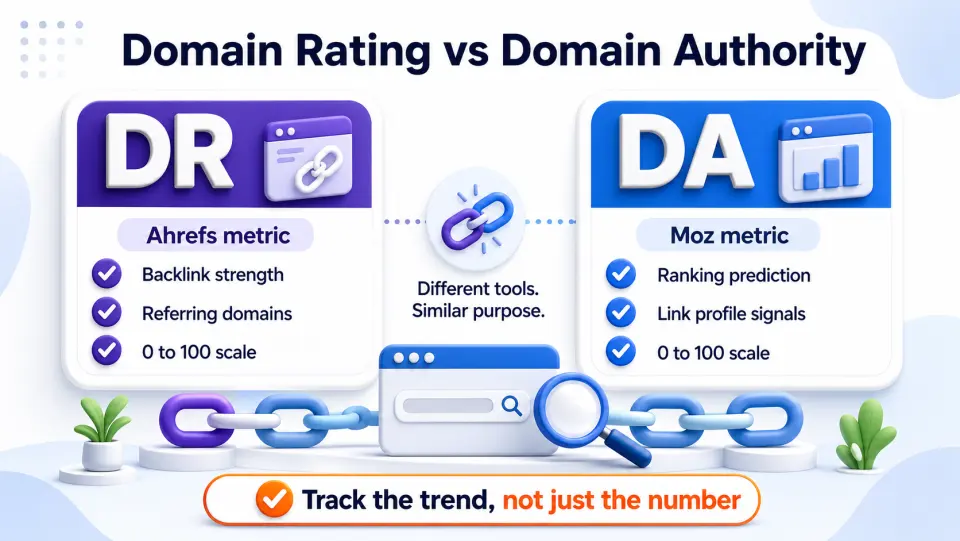
Domain Rating is a metric created by Ahrefs. It measures the strength of a website's backlink profile on a scale of 0–100. DR is calculated based on:
- The number of unique referring domains (websites linking to you)
- The DR of those referring domains
- Whether the links are dofollow
DR is logarithmic - moving from DR 70 to 80 is much harder than moving from DR 0 to 10. You can check any website's DR for free using the Ahrefs Domain Rating Checker or SubmitWell's free DR tool.
Domain Authority (DA) - Moz
Domain Authority is Moz's equivalent metric, also on a scale of 0–100. It's calculated using Moz's own web crawler and link index. DA considers similar factors to DR - number of linking domains, quality of those domains, and link patterns.
Neither DR nor DA is a Google metric. Both are third-party approximations of how Google assesses domain strength. They're imperfect but highly correlated with actual Google rankings.
Which Should You Track?
Track whichever tool you're already using. If you use Ahrefs for keyword research, track DR. If you use Moz, track DA.
For most early-stage startups, Ahrefs is the preferred choice because:
- The free DR checker is widely accessible
- Ahrefs has a larger link index than Moz
- DR scores tend to correlate more closely with actual Google rankings in most studies
The important thing is consistency - pick one metric and track it over time to measure your backlink building progress.
Which Metric Matters More for New Startups?
For a new startup, the exact metric matters less than the direction of the metric. A site moving from DR 0 to DR 15 is usually building a healthier backlink profile, even if its Moz DA updates at a different speed.
If you are doing early SEO, use DR or DA as a progress indicator rather than a ranking promise. Pair it with referring domains, backlink quality, indexed pages, and organic impressions in Google Search Console. That gives you a more complete view of whether your authority is actually improving.
How Founders Should Use DR and DA in Practice
Use these metrics for three practical decisions:
- Benchmarking competitors - If every competitor on page one has DR 40+, a DR 2 site will need more authority before competing for broad keywords.
- Tracking backlink work - If you are submitting to directories, earning mentions, and publishing useful content, DR and DA should trend upward over time.
- Prioritising keywords - Low-DR sites should start with specific long-tail keywords before chasing broad commercial terms.
The goal is not to chase the number blindly. The goal is to build enough authority that your best pages have a fair chance to rank.
Why the Numbers Often Differ Between Tools
Your DR on Ahrefs and DA on Moz are often different numbers - sometimes significantly. This is normal and expected. Each tool has its own web crawler with different coverage, and each uses a proprietary algorithm. Neither is "right" - they're both approximations.
Don't obsess over the absolute number. Focus on the trend: is your DR/DA going up over time as you build backlinks? That's the signal that matters.
How to Improve Both Metrics
The underlying driver of both DR and DA is the same: quality backlinks from high-authority domains.
The fastest way to build both metrics from zero:
1. Directory submissions - 50+ backlinks from DR 40–90 platforms in one submission run 2. HARO - High-DR editorial backlinks from media mentions 3. Guest posts - Targeted backlinks from industry-relevant, high-authority blogs 4. Linkable tools and content - Assets that naturally attract backlinks over time
Check your Domain Rating for free
SubmitWell includes a free Domain Rating checker on our homepage. Then let us help you improve it - starting at $35 for 50 directory submissions.
See Plans - Starting at $35Frequently Asked Questions
Does Google use Domain Rating or Domain Authority?
Neither. Google has its own internal PageRank algorithm that it doesn't publish. DR and DA are third-party approximations that correlate with Google's signals but are not the same thing.
What DR/DA should I aim for?
For early-stage startups, DR 20–30 is a meaningful first milestone. This level of domain authority supports ranking for low-competition long-tail keywords. DR 40+ starts to give you an edge in more competitive niches.
My DR dropped - what happened?
DR can drop if links are removed, if Ahrefs updates its crawler and finds fewer live links, or if competing websites grew their DR faster than you. A small drop doesn't necessarily indicate a problem.
Useful tools for this guide
Check your Domain Rating for free
SubmitWell includes a free Domain Rating checker on our homepage. Then let us help you improve it - starting at $35 for 50 directory submissions.
See Plans & PricingOne-time payment. No subscription.