
How to Choose the Right Directory Submission Service
Startup directories are one of the fastest ways to get backlinks, traffic, and visibility when your product is brand new. But not all directory submission services are the same. Some services blast your link to hundreds of low-quality directories. Others place you in real, active directories by hand.
In this guide
- 1.Why Directory Submissions Still Matter
- 2.What to Look For in a Directory Submission Service
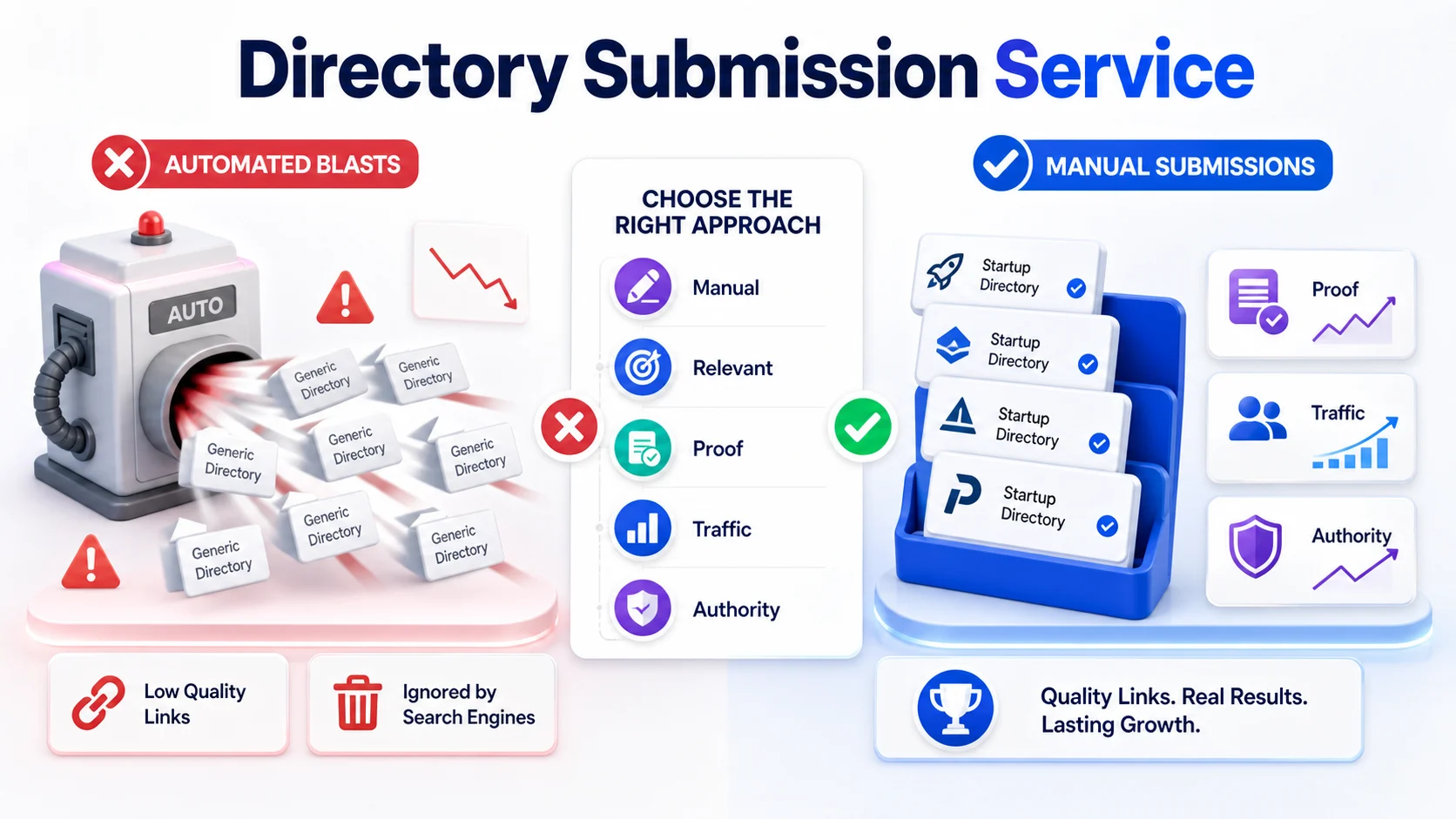
- 3.Automated Blast Services vs Manual Submission Services
- 4.A Simple Way to Check a Service Before You Pay
- 5.Common Mistakes Founders Make
- 6.Real-World Example
- 7.Where SubmitWell Fits
Why Directory Submissions Still Matter
Some founders think directory submissions do not work anymore. That is not quite true. The tactic did not stop working. Bad, spammy versions of it did.
Getting listed on low-quality, robot-submitted directories never helped much. It can still leave behind a trail of weak links that do little for rankings or trust.
Done the right way, directory submissions can still help:
- Build early backlinks for a brand-new site with almost no link profile
- Send referral traffic from directories people actually visit
- Help more people discover your startup in startup lists and tool directories
- Build trust by placing your product next to other real products
The real question is not whether you should do directory submissions. It is which service actually does the work well.
What to Look For in a Directory Submission Service
1. Manual vs automated submission
This is the biggest thing to check. Automated tools send your link to hundreds of directories using a script. They usually do not check whether the directory fits your niche, whether it is still active, or whether the listing was submitted correctly.
Manual directory submission means a real person picks directories that fit your business, fills out each form properly, and checks whether the listing went live. Automated tools are faster and cheaper, but they are also the reason directory submissions got a bad name in SEO.
2. Directory quality and fit
Ask whether the service checks how strong, relevant, and active each directory is before submitting. Startup and SaaS directories are usually more useful than generic "submit your website" pages.
One link from a real, well-run directory is worth more than dozens of junk directory links.
3. Clear list of where you are listed
A good service tells you exactly which directories you were submitted to and which listings went live. Be careful with vague claims like "submitted to 200+ sites" when there is no proof.
4. No promise of 100% approval
Real directories have rules. They reject some products. That is normal. A service promising every single directory will accept you may be using low-quality directories that accept almost anything.
5. Honest timeline and communication
Manual submission takes time. Someone has to read rules, write a good listing, submit details, and follow up. A credible service should be honest that this can take days to a few weeks, not instant.
6. Pricing that matches your goal
Some services charge per directory. Some charge a flat fee for a submission batch. Some offer recurring plans for ongoing submissions. A one-time batch may be enough for a single launch. Ongoing submission makes more sense if you launch multiple products or want continued link building.
Automated Blast Services vs Manual Submission Services
Here is the practical difference founders should understand before paying.
| What matters | Automated blast services | Manual submission services |
|---|---|---|
| How directories are picked | In bulk, often without fit checks | Picked by hand to match your niche |
| Quality checks | Almost none | Checked against each directory rules and relevance |
| Risk of spammy links | High | Low when directories are curated |
| Transparency | Often vague about where links were submitted | Shows the real directory list and status |
| Traffic value | Low if directories are dead or inactive | Higher when directories have real visitors |
| Timeline | Instant or very fast | A few days to a few weeks |
| Best for | Usually not a good fit for serious founders | Founders who want real backlinks, traffic, and proof |
A Simple Way to Check a Service Before You Pay
Ask these questions before choosing a directory submission service:
- Can they show real examples of past listings or proof reports?
- Do they explain how they pick directories, not just how many they use?
- Does a real person check each directory rules before submitting?
- Do they avoid promising 100% approval?
- Do they focus on founders, SaaS, and startups, or do they submit any business to any list?
- Do they adapt your startup description for the directory instead of pasting the same copy everywhere?
You can also prepare better inputs before buying any service. Use the Directory Description Generator, Startup Tagline Generator, and Product Hunt Description Generator to create cleaner copy before submitting.
Common Mistakes Founders Make
Founders usually go wrong in a few predictable ways:
- Picking the cheapest option without checking quality
- Paying for a $10 blast to hundreds of directories
- Using the same generic description everywhere
- Ignoring whether each directory fits the product niche
- Treating directory submission as a one-time job forever
- Not checking the results, referral traffic, or live links
The best directory submission strategy is smaller, cleaner, and easier to verify. Quality beats quantity, especially for new startup sites trying to build a trustworthy link profile.
Real-World Example
A solo SaaS founder used an automated blast service and got submitted to more than 150 directories in one day. Six months later, an SEO check showed that most of those directories were dead, inactive, low-quality, or barely trusted.
The links hardly helped rankings or traffic.
The founder then switched to manual submission across 25 real, active, relevant directories. That smaller batch brought more referral traffic in one month than the automated blast brought in six months.
That is the difference between counting submissions and building useful visibility.
Where SubmitWell Fits
SubmitWell is built around manual directory submission. The goal is not to blast your startup everywhere. The goal is to submit it to real, checked directories where founders, buyers, and search engines can actually discover it.
Each submission run focuses on:
- Relevant startup and SaaS directories
- Human-written or adapted listing copy
- Manual form submission
- Screenshot proof and submitted links
- Safer backlink building without automated spam
That makes it a better fit for founders who want authority and referral traffic, not just a large submission number on a sales page.
Choose manual submissions over automated blasts
SubmitWell manually submits startups to curated directories, sends proof reports, and focuses on relevant links that can support authority, referral traffic, and long-term SEO.
See Plans - Starting at $35Frequently Asked Questions
Do directory submissions still help SEO in 2026?
Yes, if you use real, active, well-run directories. Low-quality submissions gave the tactic a bad name, but relevant directory listings can still help with discovery, backlinks, and referral traffic.
What is the difference between automated and manual directory submission?
Automated tools send your link to many directories with little or no quality control. Manual submission means a real person chooses relevant directories and fills out each listing properly.
How many directories should I submit to?
Quality beats quantity. For many startups, 20 to 30 real, active, relevant directories can be more useful than hundreds of random low-quality directories.
Can directory submissions get my site in trouble with Google?
They can be risky if the directories are spammy, irrelevant, or part of a link scheme. Real, relevant directory listings are a normal part of building early visibility.
How long until I see results from directory submissions?
Referral traffic can appear soon after listings go live. SEO impact usually takes a few weeks to a few months because search engines need to crawl and evaluate the links.
Should I write a different description for each directory?
Yes. Adapting the description to each directory audience, category, and character limit usually performs better than copying the same generic text everywhere.
What are warning signs of a bad submission service?
Warning signs include 100% approval promises, no proof report, very cheap bulk submissions, vague directory lists, and no explanation of how directories are selected.
Is it worth paying for a service instead of doing directory submissions myself?
It depends on your time. Doing it properly means finding directories, checking rules, adapting copy, submitting forms, and tracking results. A manual service saves time while keeping the work cleaner.
Useful tools for this guide
Choose manual submissions over automated blasts
SubmitWell manually submits startups to curated directories, sends proof reports, and focuses on relevant links that can support authority, referral traffic, and long-term SEO.
See Plans & PricingOne-time payment. No subscription.