
What Is Off-Page SEO?
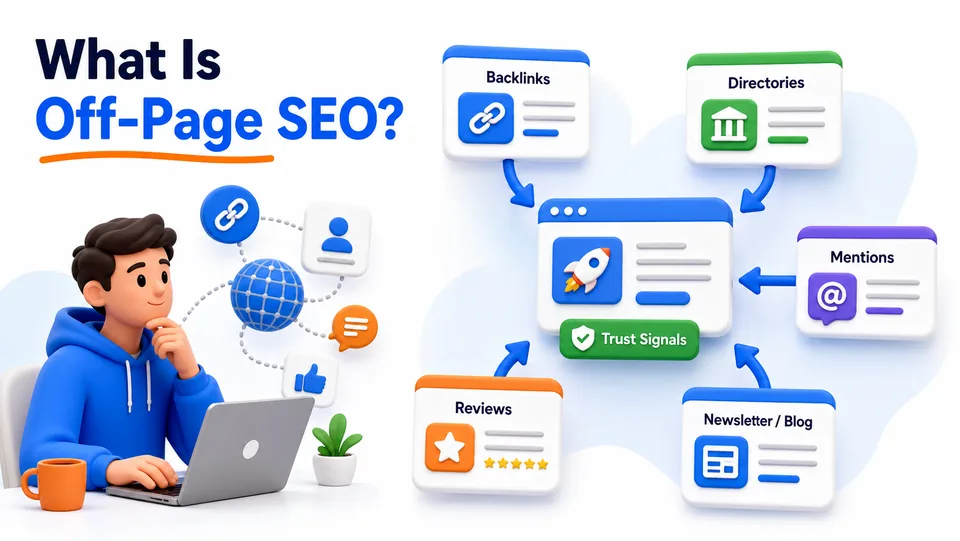
You can fix every heading, every title tag, and every image on your site, and still not rank. That is usually the point where founders discover off-page SEO. It is the part of SEO that happens away from your own pages: what other websites say about you, link to you, and how trustworthy your brand looks across the internet.
In this guide
- 1.What Off-Page SEO Actually Means
- 2.Why Off-Page SEO Matters More for New Startups
- 3.The Core Types of Off-Page SEO
- 4.On-Page vs. Off-Page SEO
- 5.How to Start Building Off-Page SEO
- 6.Common Off-Page SEO Mistakes to Avoid
- 7.Pros and Cons of Off-Page SEO
- 8.A Simple Monthly Off-Page Routine
- 9.Final Thoughts
What Off-Page SEO Actually Means
Off-page SEO covers everything that happens outside your own website that affects how search engines see you. The biggest piece of this is backlinks, other websites linking to yours, but it also includes brand mentions, social signals, reviews, and how consistently your business is listed across the web.
If on-page SEO is about proving your page deserves to rank, off-page SEO is about proving other people already trust it enough to point their own visitors toward it.
Search engines treat this as a vote of confidence. A page you wrote about yourself is one opinion. A dozen other independent sites linking to that same page is a much stronger signal that it is worth showing to searchers.
Why Off-Page SEO Matters More for New Startups
Established companies often rank well even with average on-page SEO, simply because they have built up years of backlinks and brand mentions. A new startup does not have that history yet, which means off-page work carries more weight early on.
This is also where a lot of early-stage founders get stuck. They have written good content, fixed their titles and headings, and still see no movement because nothing outside their own site is pointing back to it yet.
The Core Types of Off-Page SEO
1. Backlinks
A backlink is simply a link from another website to yours. Not all backlinks are equal, though. A link from a well-known, relevant site carries far more weight than a link from a random, unrelated blog.
What tends to matter most:
- Relevance: a link from a startup or tech blog matters more than one from an unrelated niche
- Authority: links from established, trusted sites carry more weight
- Placement: a link inside the actual content of a page is stronger than one buried in a footer
2. Directory Submissions
Submitting your startup to relevant directories like Product Hunt, BetaList, or niche SaaS directories is one of the most accessible ways to earn early backlinks. These directories are often already trusted by search engines, and getting listed gives you a legitimate, relevant link without needing an existing relationship with another site owner.
This is also one of the few off-page tactics a solo founder can realistically do in a weekend. Doing it manually across dozens of directories is tedious, which is part of why tools like SubmitWell exist: to handle the repetitive submission work across many directories at once, rather than filling out the same form fifty times by hand.
3. Guest Posting
Writing an article for another website, with a link back to yours, is a classic off-page tactic that still works when done well. The key is relevance and quality. A genuinely useful guest post on a site your target audience already reads is far more valuable than a low-effort post placed purely for the link.
4. Digital PR and Brand Mentions
Getting mentioned in a news article, a roundup post, or an industry newsletter builds authority even when there is no direct link. Search engines increasingly pick up on brand mentions as a trust signal, not just literal hyperlinks.
5. Social Signals
Shares, comments, and engagement on social platforms do not directly boost rankings the way backlinks do, but they increase the chances that someone sees your content and links to it from their own site or blog. Think of social media as a distribution channel that feeds your other off-page efforts.
6. Reviews and Reputation
For SaaS products especially, reviews on platforms like G2, Capterra, or Trustpilot serve as a form of off-page trust signal. They influence both search visibility and whether a potential customer actually clicks through and converts once they find you.
On-Page vs. Off-Page SEO
On-page SEO happens directly on your website. It controls titles, headings, content, internal links, image alt text, and page speed. You can change these instantly because they are fully in your hands.
Off-page SEO happens outside your website. It includes backlinks, mentions, directory listings, reviews, and reputation signals. It builds gradually over time because it depends partly on other platforms and other people.
Neither one works well alone. On-page SEO makes sure a page is capable of ranking. Off-page SEO gives search engines a reason to trust it enough to actually rank it.
How to Start Building Off-Page SEO
Step 1: Get the Easy Wins First
Before chasing hard-to-get backlinks, submit your startup to relevant, reputable directories. This is low effort, generally safe, and gives you your first set of legitimate backlinks quickly.
Step 2: Identify Sites Already Talking About Your Space
Search for blogs, newsletters, and roundup posts covering your industry or competitors. These are natural targets for outreach, since they have already shown interest in the topic.
Step 3: Create Something Worth Linking To
Backlinks tend to follow genuinely useful content: original data, a free tool, a detailed guide, or a resource people bookmark. Founders often skip this step and go straight to asking for links, which rarely works without something valuable to point to.
Step 4: Reach Out, Personally
Generic link-request emails get ignored. A short, specific message referencing the actual article or post you are reaching out about performs far better than a templated pitch sent to fifty people at once.
Step 5: Track What Is Working
Use a free tool like Google Search Console to monitor which pages are gaining impressions over time, and a backlink checker to see which links you have actually earned. This tells you which tactics are worth repeating.
Common Off-Page SEO Mistakes to Avoid
- Buying low-quality backlinks. Cheap, bulk link packages from unrelated sites can do more harm than good and may violate search engine guidelines.
- Ignoring relevance. A hundred unrelated links matter less than a handful from sites your actual audience trusts.
- Treating directory submission as a one-time task. New, relevant directories appear over time, so it is worth checking in periodically.
- Expecting instant results. Off-page SEO compounds over months, not days.
- Neglecting reviews. Founders often focus entirely on links and forget that reviews on platforms like G2 or Capterra also shape trust and visibility.
Pros and Cons of Off-Page SEO
Pros
- Builds long-term authority that is hard for competitors to quickly replicate
- Often drives direct referral traffic, not just search rankings
- Reviews and mentions build trust that supports conversions, not just visibility
Cons
- Slower to show results than on-page fixes
- Partly outside your direct control because you cannot force another site to link to you
- Requires ongoing effort rather than a one-time setup
A Simple Monthly Off-Page Routine
- Submit to 2 to 3 new relevant directories you have not listed on yet
- Reach out to 3 to 5 relevant blogs or newsletters with a specific pitch
- Check for new mentions of your brand using a free alert tool
- Review your backlink profile for anything low-quality or spammy
- Ask 2 to 3 recent customers for a review on a relevant platform
Final Thoughts
Off-page SEO is not about chasing every possible link. It is about steadily building genuine signals of trust: relevant backlinks, honest reviews, and real mentions that tell search engines your startup is worth showing to more people.
Start with the accessible wins. Get listed in the directories relevant to your space, ask early customers for honest reviews, and build outward from there. It compounds slowly, but it compounds.
If you have not started with directory submissions yet, that is the easiest first step. SubmitWell helps you get your startup listed across relevant directories in one place, so you can focus your time on outreach and content instead of filling out the same submission form over and over.
Start building off-page trust signals
SubmitWell helps you get listed across relevant startup directories so your website can begin earning backlinks, referral traffic, and early trust signals.
See Plans - Starting at $35Frequently Asked Questions
What is off-page SEO in simple terms?
Off-page SEO is everything that happens outside your own website that helps search engines trust and rank your pages, mainly backlinks, brand mentions, and reviews from other sources.
Is off-page SEO more important than on-page SEO?
Neither is more important on its own. On-page SEO makes a page capable of ranking, while off-page SEO gives search engines a reason to trust and rank it. Both are usually needed together.
How long does off-page SEO take to show results?
It varies, but most founders see gradual improvement over a few months rather than an instant change, since backlinks and mentions need time to be discovered and trusted by search engines.
Are directory submissions still effective for SEO?
Yes, when submitted to relevant, reputable directories. They remain one of the more accessible ways for new startups to earn early, legitimate backlinks.
Can social media posts directly improve my rankings?
Not directly in most cases, but social engagement increases visibility, which can lead to other sites linking to your content, and those links can support rankings.
Useful tools for this guide
Related Resources
Start building off-page trust signals
SubmitWell helps you get listed across relevant startup directories so your website can begin earning backlinks, referral traffic, and early trust signals.
See Plans & PricingOne-time payment. No subscription.