
Why Domain Rating Matters for Early-Stage Startups
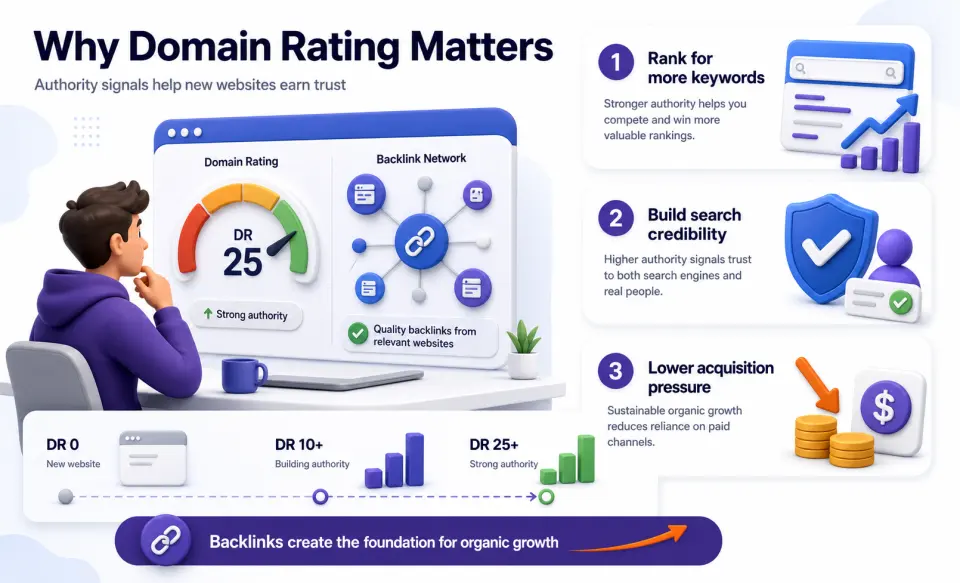
Many founders treat Domain Rating as a number to improve for its own sake - a vanity metric for SEO enthusiasts. It's not. DR has real, measurable effects on your startup's ability to grow organically. Here's why it matters and what happens when you improve it.
In this guide
- 1.What Domain Rating Actually Measures
- 2.How DR Affects Your Ability to Rank
- 3.DR Affects Your Paid Ad Costs Too
- 4.DR as a Trust Signal
- 5.Why Low DR Makes Early SEO Slower
- 6.What to Do When Your DR Is Still Zero
- 7.How Quickly Can You Move DR?
What Domain Rating Actually Measures
Domain Rating (DR), created by Ahrefs, measures the strength of your website's backlink profile on a 0–100 scale. At its core, it captures how many quality websites link to yours and how authoritative those websites are.
A site with DR 50 has more high-quality backlinks than a site with DR 20. And a site with DR 50 will, all else being equal, rank higher in Google for competitive keywords than a DR 20 site.
How DR Affects Your Ability to Rank
Google's ranking algorithm considers hundreds of signals, but domain authority (which DR approximates) is one of the most significant. Here's what this means practically:
DR 0–10: Your site can rank for exact brand name searches but almost nothing competitive. Even low-volume long-tail keywords are difficult.
DR 10–25: You can rank for very specific, low-competition long-tail keywords - often including your product category plus multiple qualifiers.
DR 25–45: Medium-competition keywords become achievable. You can compete in your niche against similarly-aged startups.
DR 45+: High-competition terms become realistic with strong content to support them.
DR Affects Your Paid Ad Costs Too
This is often overlooked. Google's Quality Score for ads is partially influenced by landing page quality and user experience signals - which correlate with organic authority. Higher DR sites tend to have:
- Better Quality Scores → lower cost-per-click
- Better ad rank for the same bid → more impressions at the same spend
Building domain authority through directory submissions and content doesn't just help organic search - it makes your paid acquisition more efficient.
DR as a Trust Signal
Beyond search rankings, domain rating functions as a trust signal in other contexts:
Investor research - Investors checking out your startup will often look at your DR. A DR of 0 on a product that's been live for 6 months raises questions.
Partnership decisions - Potential integration partners or affiliates sometimes check DR before agreeing to link to your site.
Media coverage - Some journalists use DR as a quick filter when deciding whether to cover a startup.
Why Low DR Makes Early SEO Slower
A new site with DR 0 can still publish great content, but Google has fewer external signals to trust it. That is why early posts often take longer to index, rank lower for competitive searches, or only show for exact brand searches.
Building a clean backlink foundation helps reduce that friction. Directory profiles, founder communities, partner mentions, and legitimate resource pages all create signals that your startup exists outside its own website.
What to Do When Your DR Is Still Zero
If your DR is still zero, start with foundational links before trying advanced SEO tactics. Claim your startup profiles, submit to relevant directories, make sure your social profiles link back to your site, and publish a few useful pages that explain your product clearly.
The first goal is simple: move from no authority signals to a visible backlink footprint. Once that foundation is in place, content, outreach, and comparison pages have a much better chance of working.
How Quickly Can You Move DR?
Starting from zero:
Weeks 1–4: Directory submissions go live. Google starts crawling new backlinks.
Weeks 4–8: DR begins to move in Ahrefs as backlinks are indexed. A 50-directory submission run can move DR from 0 to 8–18 in this window.
Months 2–4: Continued link acquisition from HARO, guest posts, and content starts compounding on top of the directory foundation.
Month 6+: If you've been consistent, DR 25–40 is achievable for most startups - and that's enough to rank for a meaningful set of commercial keywords.
Check your DR - then improve it
Use our free Domain Rating checker on the homepage. Then let us build your backlink profile through 50–200+ directory submissions. Starting at $35.
See Plans - Starting at $35Frequently Asked Questions
Is DR the same as Google PageRank?
No. DR is Ahrefs' proprietary metric. Google's PageRank algorithm is not publicly available. DR correlates strongly with PageRank-related signals but is not the same thing.
Can DR decrease?
Yes. If referring domains remove their links, or if Ahrefs updates its crawler and finds fewer live links, DR can drop. Competitors increasing their DR faster than you can also make your relative position worse even if your absolute score stays the same.
What's a good DR for a startup that's 6 months old?
DR 15–30 is a realistic and healthy target for a 6-month-old startup that has done a directory submission campaign and some content marketing. DR 30+ at 6 months suggests a strong backlink strategy is in place.
Useful tools for this guide
Related Resources
Check your DR - then improve it
Use our free Domain Rating checker on the homepage. Then let us build your backlink profile through 50–200+ directory submissions. Starting at $35.
See Plans & PricingOne-time payment. No subscription.