
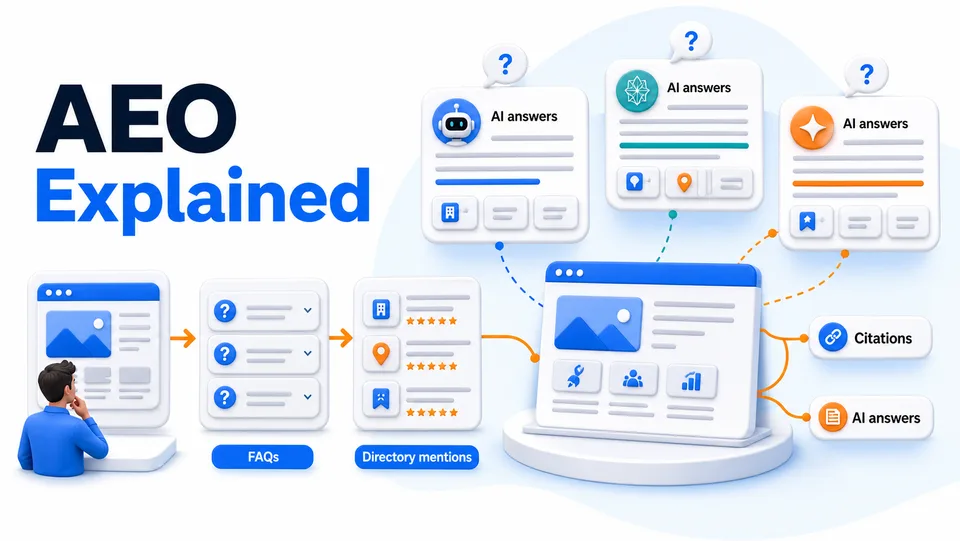
AEO Explained
Five years ago, getting found online meant one thing: ranking on Google. Today, a growing share of your future customers are not scrolling through blue links at all. They are asking ChatGPT for the best tool for a job, searching Perplexity, or reading Google AI Overviews. If your startup is not one of the sources those systems understand, you are invisible to that slice of search traffic.
In this guide
- 1.What Is AEO?
- 2.Why AEO Matters More Than Ever for Startups
- 3.AEO vs SEO
- 4.How AI Answer Engines Choose Sources
- 5.8 Practical Ways to Optimize for AEO
- 6.Common AEO Mistakes to Avoid
- 7.Pros and Cons of Investing in AEO Right Now
- 8.A Simple AEO Starting Checklist
- 9.Conclusion
What Is AEO?
AEO stands for Answer Engine Optimization. It is the practice of structuring your content so that AI systems like ChatGPT, Google AI Overviews, Perplexity, and Claude can easily find it, understand it, and use it to answer a user's question.
Traditional SEO optimizes for ranking pages in a list of search results. AEO optimizes for something different: getting your brand, product, or content directly cited or summarized inside an AI-generated response.
Think of the difference this way. With SEO, your goal is to be the blue link someone clicks. With AEO, your goal is to be the fact, quote, or recommendation an AI model pulls into its answer, sometimes with a link and sometimes without one.
Both goals matter. But they require slightly different tactics, and founders who only optimize for one are leaving visibility on the table.
Why AEO Matters More Than Ever for Startups
AI-powered search is not a niche behavior anymore. Millions of people now ask AI tools questions they used to type into Google, especially research-heavy or comparison-heavy queries like "best CRM for freelancers" or "how does X tool compare to Y."
For early-stage startups, this shift is actually an opportunity, not a threat.
Lower competition. Most AI answer engines are still relatively new, and most companies have not optimized for them yet. That means a well-optimized page can get cited even if your domain is not old or authoritative.
Higher-intent traffic. Someone who reads an AI summary and clicks through to your site has already been pre-sold on why you might be relevant. These visitors tend to convert well.
Brand exposure without a click. Even if a user never visits your site, being named inside an AI answer builds recognition. Over time, repeated mentions compound into brand trust.
A new distribution channel. For indie hackers and bootstrapped SaaS founders who cannot outspend larger competitors on ads, AEO offers a more level playing field.
The catch is that AI answer engines do not work exactly like traditional search crawlers. Getting cited requires a different content approach.
AEO vs SEO
AEO and SEO overlap more than they conflict. A technically healthy, well-structured website is still the foundation for both. But the priorities shift once you dig into the details.
Traditional SEO
- Primary goal: rank in search results pages
- Content format: long-form pages optimized for keywords
- Success metric: rankings, organic clicks
- Structure: headings, internal links, keyword coverage
- Authority signal: backlinks, domain age, and site trust
- User outcome: click to your site to read more
AEO
- Primary goal: get cited or summarized in AI answers
- Content format: clear, extractable answers to specific questions
- Success metric: citations, brand mentions, and AI-driven traffic
- Structure: direct answers, structured data, and Q&A formatting
- Authority signal: consistent facts across the web and clear sourcing
- User outcome: get an answer with or without visiting your site
SEO rewards depth and persuasion. AEO rewards clarity and extractability. An AI model scanning your page is looking for a clean, well-defined answer it can lift and rephrase, not a long narrative buildup before the point.
That does not mean you should abandon long-form content. It means you need to structure that content so both humans and AI systems can find the answer quickly.
How AI Answer Engines Choose Sources
AI models do not rank pages in the same way Google's traditional algorithm does. Most modern answer engines rely on a mix of signals:
Live web retrieval. Tools like Perplexity, ChatGPT with browsing, and Google AI Overviews search the live web, often using existing search indexes, to pull in current, relevant pages.
Content clarity. Pages with clearly labeled questions and direct answers are easier for the model to extract and summarize accurately.
Structured data. Schema markup, especially FAQ and HowTo schema, helps machines understand exactly what a page is answering.
Consistency across the web. If your product description, pricing, or positioning is stated the same way across your site, directories, review platforms, and social profiles, AI models are more likely to trust and repeat that information.
Source credibility. Being mentioned on reputable third-party sites like directories, review platforms, and industry publications adds a layer of trust that a standalone company blog cannot generate alone.
This last point is where a lot of founders miss an easy win. AI models often pull information not just from your website, but from how your product is described elsewhere. That is part of why getting listed on well-maintained startup directories, review sites, and niche platforms has become more valuable, not less, in the AEO era.
8 Practical Ways to Optimize for AEO
You do not need a massive content team to start improving your AEO visibility. Focus on these first.
1. Answer questions directly, early in the content
Do not bury your answer under three paragraphs of introduction. If someone might ask "what does your product do," answer that question in the first sentence or two of the relevant page, then expand with detail afterward.
2. Build a real FAQ section
FAQ sections are not just good for user experience. They map almost perfectly to how people phrase questions to AI tools. Structure each question as a full sentence, followed by a concise, factual answer of two to four sentences.
3. Use FAQ and HowTo schema markup
Schema markup is structured code that tells search engines and AI crawlers exactly what type of content is on a page. Adding FAQ schema to your FAQ sections makes it easier for AI systems to lift accurate answers instead of guessing.
4. Keep your product description consistent everywhere
Pick one clear, accurate way to describe what your startup does, and use nearly identical language across your homepage, directory listings, social bios, and press mentions. Inconsistent descriptions confuse both search engines and AI models.
5. Get listed on relevant, well-maintained directories
Directories still matter, but their role has evolved. Instead of being primarily a backlink source, directory listings now double as structured, third-party confirmation of what your product does. A clean, accurate listing on a curated site like SubmitWell can reinforce the same facts an AI model might already be seeing on your own website.
6. Write comparison and vs content honestly
A large share of AI-answered questions are comparison questions: "X vs Y," "best alternative to X," and "cheapest option for Y." Publishing honest, well-researched comparison pages, including your product's real limitations, makes that content more likely to be trusted and cited than one-sided marketing copy.
7. Use clear headings that mirror real questions
Instead of a heading like "Our Approach," use "How Does This Product Handle Data Privacy?" Headings phrased as questions are more likely to match how users phrase prompts to AI tools.
8. Keep technical SEO healthy
AEO does not replace technical SEO fundamentals. It depends on them. Fast page speed, mobile-friendly design, clean URL structures, and crawlable pages all still matter because most AI answer engines rely on the same underlying web index that traditional search does.
Common AEO Mistakes to Avoid
Even well-intentioned founders trip up on a few recurring issues.
- Writing FAQs that do not match real questions. Made-up, overly generic questions rarely match how people actually ask AI tools things.
- Keyword stuffing instead of answering clearly. AI models reward clarity, not repetition.
- Ignoring third-party mentions. Focusing only on your own website while ignoring directory listings, review sites, and community mentions leaves a major trust signal untouched.
- Making ambiguous or inconsistent claims. If your pricing page says one thing and your directory listing says another, you create confusion that erodes trust.
- Treating AEO as a one-time project. AI answer engines update their retrieval and training data continuously. AEO is an ongoing habit, similar to SEO.
Pros and Cons of Investing in AEO Right Now
Pros
- Early-mover advantage while most competitors have not optimized for it yet
- Reinforces good SEO fundamentals you likely need anyway
- Builds brand consistency across the web
- Can drive high-intent traffic and direct brand mentions
Cons
- Metrics and tracking tools for AEO performance are still maturing
- AI answer engines change their retrieval methods frequently
- Some AI-driven visibility does not translate into a click or trackable traffic
- Results can be harder to measure compared to traditional keyword rankings
Despite the uncertainty, the direction is clear: AI-assisted search is growing, and the startups building good habits now will have a head start once measurement tools catch up.
A Simple AEO Starting Checklist
If you only have an hour this week, focus here:
- Pick your 5 most common customer questions and write clear, direct answers.
- Add those as a proper FAQ section with FAQ schema on your homepage or main product page.
- Audit your product description across your website, directories, and social profiles for consistency.
- Identify one or two comparison pages worth writing honestly.
- Make sure your startup is listed accurately on a few relevant, well-maintained directories.
None of these require a big budget. They require consistency and clarity, two things AI answer engines reward heavily.
Conclusion
AEO is not a replacement for SEO, and it is not a passing trend. It is a natural evolution of how people find information, and it rewards the same qualities good marketers have always valued: clarity, honesty, and consistency.
For startup founders and indie hackers, the opportunity right now is real. Most companies have not structured their content for AI answer engines yet, which means the founders who start today have a genuine head start.
Start small. Clean up your FAQs, tighten your product description, and make sure your startup is accurately represented everywhere it appears online, including the directories and platforms AI models often pull from.
If you are looking for a straightforward way to get your startup listed on curated, well-maintained directories that reinforce accurate, consistent information about your product, SubmitWell handles manual directory submissions so you do not have to track down and fill out dozens of forms yourself.
Make your startup easier for answer engines to trust
SubmitWell helps you publish consistent startup listings across relevant directories, supporting both SEO backlinks and AEO trust signals.
See Plans - Starting at $35Frequently Asked Questions
What does AEO stand for?
AEO stands for Answer Engine Optimization. It means optimizing content so AI-powered tools like ChatGPT, Perplexity, and Google AI Overviews can find, understand, and cite it when answering user questions.
Is AEO replacing SEO?
No. AEO builds on top of solid SEO fundamentals rather than replacing them. Technical health, site structure, and content quality still matter for both.
How is AEO different from traditional SEO?
Traditional SEO focuses on ranking in search results so users click through to your site. AEO focuses on getting your content cited or summarized directly inside an AI-generated answer.
Do I need schema markup for AEO?
It is not strictly required, but FAQ and HowTo schema make it significantly easier for AI systems to identify and extract accurate answers from your pages.
Do directory listings help with AEO?
They can. Accurate, consistent listings on well-maintained directories reinforce the same facts AI models may already be pulling from your website, which strengthens trust and consistency signals.
How do I measure AEO success?
Measurement tools are still evolving. For now, founders can track brand mentions in AI tools manually, watch referral traffic from AI platforms, and monitor whether comparison or FAQ content gets cited.
Useful tools for this guide
Related Resources
Make your startup easier for answer engines to trust
SubmitWell helps you publish consistent startup listings across relevant directories, supporting both SEO backlinks and AEO trust signals.
See Plans & PricingOne-time payment. No subscription.