
How to Build Trust Signals for a New SaaS Website
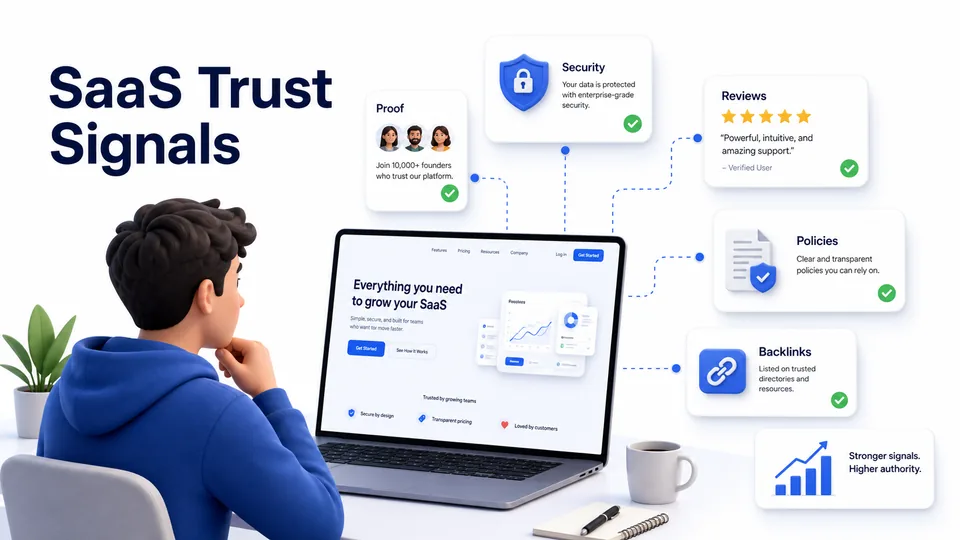
A new SaaS website has two jobs. It needs to explain the product clearly, and it needs to make visitors believe the company is real, safe, and worth trying. That second job is where trust signals matter. Trust signals are not just testimonials or badges. They include clear pricing, real company information, security pages, refund terms, support access, external mentions, directory profiles, reviews, backlinks, and structured data that helps search engines and AI systems understand the business.
In this guide
- 1.What Are SaaS Trust Signals?
- 2.Why Trust Signals Matter for SEO and AI Visibility
- 3.What Most Trust Signal Guides Miss
- 4.Homepage Trust Signals
- 5.Pricing and Checkout Trust Signals
- 6.Security, Privacy, and Support Signals
- 7.External Trust Signals
- 8.Search and AI-Readable Trust Signals
- 9.Trust Signals to Avoid
- 10.A 14-Day Trust Signal Plan for New SaaS Websites
- 11.How SubmitWell Helps Build External Trust Signals
What Are SaaS Trust Signals?
SaaS trust signals are the visible and crawlable details that reduce doubt around your product. They help a visitor answer simple questions before signing up, booking a demo, or paying for a plan:
- Is this product real?
- Who is behind it?
- Can I understand the pricing?
- Is my data safe?
- Can I contact support?
- Have other people used it?
- Are there trusted websites mentioning it?
- Does the brand appear consistently across the web?
For a new SaaS, trust signals are especially important because you usually do not have years of brand awareness, thousands of customers, or public case studies yet. Your site has to create confidence from smaller but believable proof points.
Why Trust Signals Matter for SEO and AI Visibility
Trust signals are not a ranking shortcut. They are part of building a website that looks reliable to users, search engines, and AI answer systems.
Google's helpful content guidance focuses on people-first content that shows experience, expertise, authoritativeness, and trust. A SaaS site supports that by showing who the product is for, what it does, who operates it, how users can get help, and what external evidence supports the brand.
AI systems also need clear context. If your SaaS has a vague homepage, no founder page, no pricing details, no policy pages, no external profiles, and no consistent mentions across the web, it becomes harder for AI tools to understand and reference your product confidently.
The goal is not to decorate the site with trust badges. The goal is to create evidence that both humans and machines can read.
What Most Trust Signal Guides Miss
Most articles about website trust signals focus on the same generic list: testimonials, reviews, security badges, logos, and guarantees. Those are useful, but they are incomplete for a SaaS website.
A stronger SaaS trust strategy also includes:
- A clear product category and use case
- Transparent pricing or a clear path to pricing
- Founder or company identity
- Real support and contact details
- Privacy, terms, refund, and cancellation pages
- Documentation, changelog, or help content
- Directory profiles and external brand mentions
- Backlinks from relevant platforms
- Metadata and structured data that describe the product
- Consistent brand information across search, social, and AI-visible sources
That is the gap this guide fills. It treats trust as a full website system, not a single testimonial block.
Homepage Trust Signals
Your homepage is usually the first trust test. A visitor should understand what your SaaS does within a few seconds, but they should also see enough proof to keep reading.
Add these homepage trust signals:
Clear positioning Say what the product does, who it is for, and what outcome it supports. Avoid abstract claims like "revolutionary platform" or "all-in-one solution" unless the page explains them clearly.
Real product screenshots Show the actual product interface. Founders often hide behind illustrations, but screenshots help users believe the product exists.
Specific benefit statements Use concrete outcomes instead of vague promises. For example, "create client reports in minutes" is more credible than "scale productivity."
Founder or company proof Add a small founder note, company story, or team detail if you do not have many customer logos yet.
External proof If your product is listed on directories, featured in a launch platform, reviewed on a marketplace, or mentioned in a community post, surface that proof carefully.
Pricing and Checkout Trust Signals
Pricing pages carry a lot of trust weight because they sit close to the buying decision. If pricing feels confusing, visitors assume the product will be confusing too.
Strong pricing trust signals include:
- Clear plan names
- Transparent one-time or recurring pricing
- What each plan includes
- What happens after payment
- Refund or cancellation policy
- Delivery timelines if the product includes a service
- Support expectations
- Secure checkout flow
If you offer a guarantee, explain it plainly. Avoid overpromising. A clear guarantee is stronger than a dramatic claim that creates doubt.
Security, Privacy, and Support Signals
Even small SaaS products should make basic trust pages easy to find. You do not need enterprise compliance on day one, but you do need clarity.
Add these pages or sections:
- Privacy policy
- Terms of service
- Refund or cancellation policy if payments are involved
- Contact or support page
- Security notes for data handling
- Help docs or FAQ
- Status page if uptime is important
These pages help users, but they also help search engines and AI systems understand that the website is maintained and accountable.
External Trust Signals
A SaaS website should not exist only on its own domain. External trust signals show that other platforms know the product exists.
Useful external trust signals include:
Startup directory profiles Relevant directory listings create branded profiles, referral paths, and backlinks. They are useful for early-stage SaaS products because they create a searchable footprint outside your homepage.
Review platforms Even a few honest reviews can help if they are specific and believable.
Launch platforms Product launch sites, founder communities, and SaaS discovery platforms can create visibility and early validation.
Guest posts and mentions Helpful guest content, partner mentions, interviews, and comparison pages can build authority when they are relevant.
Social proof from real users Screenshots of customer comments, X posts, Reddit replies, or support feedback can help, but only when used honestly and with context.
Search and AI-Readable Trust Signals
Some trust signals are visible to users. Others are mainly useful because they make your site easier to parse.
For a SaaS website, add:
- Descriptive title tags and meta descriptions
- Open Graph images for social sharing
- Organization structured data
- SoftwareApplication structured data when relevant
- Breadcrumb structured data
- FAQ structured data where appropriate
- A clean sitemap.xml
- An image sitemap if your blog uses visual assets
- RSS feed for new guides and resources
- llms.txt and llms-full.txt for AI-readable context
- Consistent name, URL, and description across directories
This does not guarantee AI citations or search rankings. It simply removes ambiguity and helps systems understand your product more reliably.
Trust Signals to Avoid
Bad trust signals can hurt credibility. Avoid:
- Fake customer logos
- Fake review counts
- Security badges that do not mean anything
- Stock photos pretending to be customers
- Overstated guarantees
- Hidden pricing when buyers expect transparent pricing
- Thin policy pages copied from templates without review
- Directory submissions to spammy, irrelevant sites
- Inconsistent product descriptions across platforms
Trust is built by consistency. If your homepage says one thing, your directory profiles say another, and your pricing page is unclear, users notice.
A 14-Day Trust Signal Plan for New SaaS Websites
Here is a practical plan for a new SaaS website.
Days 1 to 3: Fix the core site Rewrite your homepage headline, add real product screenshots, clarify your pricing, and publish privacy, terms, and support pages.
Days 4 to 6: Add machine-readable context Check metadata, Open Graph tags, structured data, sitemap, RSS feed, and llms.txt. Use tools like the Meta Tag Checker, OG Image Checker, and Favicon Checker.
Days 7 to 10: Build external profiles Submit your SaaS to relevant startup directories, SaaS directories, product discovery sites, and founder platforms. Keep your product name, category, and description consistent.
Days 11 to 14: Collect proof Ask early users for short feedback, save launch mentions, document directory listings, and add a small proof section to your homepage or pricing page.
This is enough to make a new SaaS website feel more complete without waiting for a huge customer base.
How SubmitWell Helps Build External Trust Signals
SubmitWell focuses on the external trust layer. We manually submit startups and SaaS products to relevant directories and provide a report with links and screenshot proof.
That helps founders create:
- Branded directory profiles
- Relevant backlink opportunities
- Searchable mentions outside the homepage
- Referral paths from discovery platforms
- A stronger backlink foundation
- Proof that the product is listed across the web
Directory submissions should not be your entire SEO strategy. But for a new SaaS website, they are a practical early step toward visibility, trust, and stronger authority signals.
Build trust beyond your own homepage
SubmitWell helps SaaS founders create verified directory profiles, referral links, and backlink proof that support visibility and trust across the web.
See Plans - Starting at $35Frequently Asked Questions
What are trust signals for a SaaS website?
SaaS trust signals are proof points that make visitors believe the product is real and reliable. Examples include transparent pricing, product screenshots, customer reviews, policy pages, security notes, support access, directory listings, backlinks, and structured data.
Do trust signals help SEO?
Trust signals can support SEO indirectly by improving credibility, content quality, user confidence, external mentions, and backlink profile. They do not guarantee rankings, but they help create a stronger foundation for search visibility.
What trust signals should a new SaaS add first?
Start with clear positioning, real product screenshots, transparent pricing, privacy and terms pages, a contact or support path, metadata, structured data, and a few relevant external directory profiles.
Are directory listings trust signals?
Yes, relevant directory listings can act as external trust signals because they create branded profiles, referral paths, and backlinks from other websites. Quality and relevance matter more than raw submission volume.
Can trust signals help AI search visibility?
They can support AI visibility by making the product easier to understand across crawlable pages, structured data, llms.txt, directories, and consistent external mentions. They do not guarantee AI citations.
Do testimonials matter if I only have a few users?
Yes, but keep them honest and specific. A few real, detailed comments are more believable than generic praise. If you do not have testimonials yet, use founder proof, product screenshots, policy clarity, and external listings first.
Useful tools for this guide
Related Resources
Build trust beyond your own homepage
SubmitWell helps SaaS founders create verified directory profiles, referral links, and backlink proof that support visibility and trust across the web.
See Plans & PricingOne-time payment. No subscription.