
Best SEO Tools for Startups in 2026
Every startup founder eventually hits the same wall: you know SEO matters, but the tool landscape is overwhelming. There are dozens of platforms promising to fix your rankings, and most of them are built for enterprise marketing teams with big budgets, not a solo founder or a three-person team trying to get initial traction.
In this guide
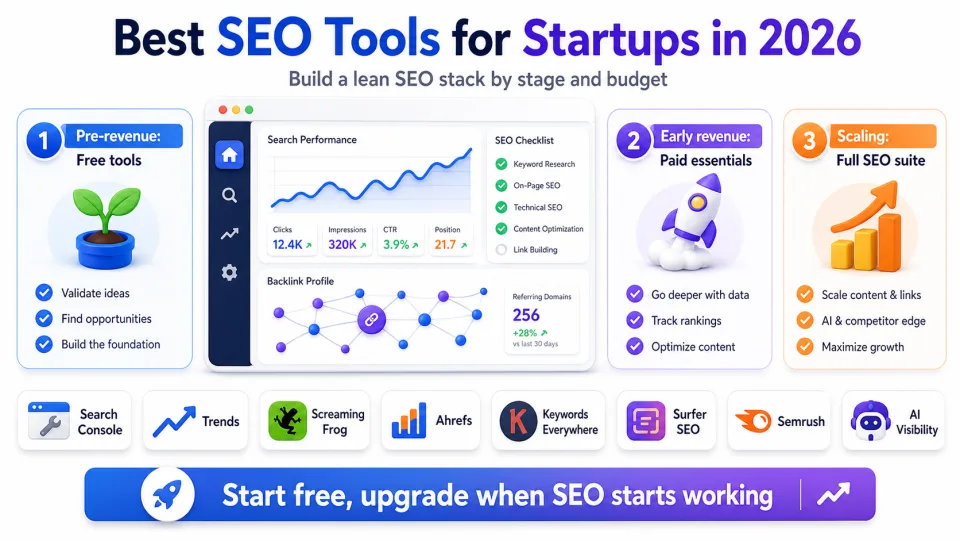
- 1.What Startups Actually Need From an SEO Stack
- 2.Free and Low-Cost Tools for Pre-Revenue Startups
- 3.Mid-Tier Paid Tools for Early Revenue and Seed Stage
- 4.Advanced and Full-Suite Tools for Series A and Beyond
- 5.Comparison Table: Best SEO Tools for Startups by Stage
- 6.How to Build Your Stack Without Overspending
- 7.Tools Measure SEO, But They Do Not Create Distribution
What Startups Actually Need From an SEO Stack
Before diving into specific tools, it helps to understand the categories a lean SEO stack should cover:
- Keyword research, to understand what your audience is actually searching for
- Technical SEO and site audits, to catch crawl errors, broken links, and indexing issues
- Rank tracking, to monitor how your pages perform over time
- Content optimization, to make sure your content satisfies search intent
- Backlink analysis, to understand your link profile and your competitors
- AI search visibility, which is increasingly important as more traffic shifts toward AI-generated answers on platforms like ChatGPT, Perplexity, and Google AI Overviews
Most startups do not need a tool for every category on day one. Start with free tools to validate demand, then layer in paid tools once you have evidence that SEO is working and worth the investment.
Free and Low-Cost Tools for Pre-Revenue Startups
Google Search Console
This is non-negotiable and completely free. It shows you exactly how Google sees your site, which pages are indexed, what queries you rank for, and any crawl errors that need fixing. If you use nothing else on this list, use this.
Google Keyword Planner
Built for ad campaigns but genuinely useful for organic keyword research too. It gives you search volume ranges and competition data for any keyword. The data comes as ranges rather than exact numbers, but for a pre-revenue startup validating demand, that is usually enough.
Google Trends
Useful for spotting whether interest in a topic is rising or falling over time. In 2026, this is particularly useful for catching AI-search-related query shifts early.
Ubersuggest
A solid, low-cost entry point for keyword research and basic site audits, with a useful free tier for founders just validating whether a niche has search demand.
Screaming Frog
The go-to tool for technical SEO audits. It crawls your site the way a search engine would and flags broken links, missing meta tags, duplicate content, and redirect issues. The free version handles up to 500 URLs, which covers most early-stage startup sites.
Mid-Tier Paid Tools for Early Revenue and Seed Stage
Ahrefs
Widely considered one of the two most comprehensive SEO platforms available, alongside Semrush. Ahrefs is generally regarded as the more intuitive option for solo founders. Its Site Explorer tool makes backlink and competitor research approachable without a steep learning curve.
Keywords Everywhere
A lightweight browser extension that shows search volume, CPC, and competition data directly inside Google search results. It is inexpensive and useful for founders who want quick keyword insights without opening a separate dashboard for every search.
Surfer SEO
Focused specifically on content optimization. It analyzes top-ranking pages for your target keyword and gives guidance on structure, word count, and related terms to include. It is useful for startups investing in content-led growth.
Advanced and Full-Suite Tools for Series A and Beyond
Semrush
An all-in-one marketing toolkit covering SEO, content, competitive research, and paid search analysis. It is more expensive than Ahrefs but tends to suit startups that already have a dedicated marketing team and need a single platform multiple people can work from.
AI Search Visibility Tools
This is a newer and rapidly growing category in 2026. These tools track whether your brand or content is being cited in AI-generated answers from tools like ChatGPT, Perplexity, and Google AI Overviews. This is meaningfully different from traditional rank tracking and increasingly relevant as more discovery shifts toward AI assistants.
Comparison Table: Best SEO Tools for Startups by Stage
Google Search Console: best for every startup from day one. Category: indexing and monitoring. Cost: free.
Google Keyword Planner: best for pre-revenue demand validation. Category: keyword research. Cost: free.
Google Trends: best for spotting rising topics. Category: trend research. Cost: free.
Ubersuggest: best for early keyword research. Category: keyword research. Cost: free or low-cost.
Screaming Frog: best for technical audits. Category: technical SEO. Cost: free up to 500 URLs.
Ahrefs: best for solo founders and seed-stage teams. Category: full SEO suite. Cost: paid starter tier available.
Keywords Everywhere: best for quick keyword lookups. Category: keyword research. Cost: low-cost.
Surfer SEO: best for content-led growth. Category: content optimization. Cost: mid-tier.
Semrush: best for teams with dedicated marketers. Category: full SEO suite. Cost: higher-tier.
How to Build Your Stack Without Overspending
A practical approach for most startups looks like this:
Stage 1: Pre-revenue or pre-launch
Stick entirely to free tools. Google Search Console, Google Trends, and a free-tier keyword tool are enough to validate that people are actually searching for what you are building.
Stage 2: Early revenue or seed
Add one paid tool that covers the most gaps in your current process. For most startups, this is either a keyword and competitor research tool like Ahrefs, or a content optimization tool like Surfer SEO if content production is your main growth lever.
Stage 3: Series A and beyond
This is when a full-suite tool like Semrush starts to make sense, particularly once you have a marketing team that needs shared access and consistent reporting.
Throughout every stage, pair whatever research and content tools you are using with consistent technical maintenance. Regular audits with something like Screaming Frog and clean indexing habits through Search Console can prevent avoidable SEO problems.
Tools Measure SEO, But They Do Not Create Distribution
It is also worth remembering that research and audit tools only tell you what is happening on your own site. They do not get you discovered elsewhere.
Pairing your SEO stack with a startup directory submission service like SubmitWell helps put your product in front of relevant, curated directories early on. That builds backlinks and referral traffic that pure analytics tools can measure, but cannot actually create for you.
Use tools to measure SEO, then build the signals
SubmitWell helps early founders build directory backlinks, referral traffic, and trust signals that your SEO tools can track over time.
See Plans - Starting at $35Frequently Asked Questions
What is the single most important SEO tool for a brand-new startup?
Google Search Console. It is free, directly tied to how Google sees your site, and there is no substitute for it regardless of what other tools you eventually add.
Do I need both Ahrefs and Semrush?
No. They cover largely overlapping functionality. Most startups pick one based on budget and learning curve preference.
Are free SEO tools good enough for a pre-revenue startup?
Yes, in most cases. Free tools like Search Console, Keyword Planner, and Google Trends give enough directional data to validate demand and fix major technical issues.
What is the difference between a keyword research tool and a content optimization tool?
Keyword research tools help you find what to write about. Content optimization tools help you structure and refine what you have already decided to write.
Is it worth paying for an AI search visibility tool in 2026?
It depends on your audience. If your customers research products through tools like ChatGPT or Perplexity, tracking AI citation visibility is becoming increasingly relevant.
How often should a startup run a technical SEO audit?
Roughly once a quarter, or immediately after any major site redesign, migration, or CMS change.
Useful tools for this guide
Related Resources
Use tools to measure SEO, then build the signals
SubmitWell helps early founders build directory backlinks, referral traffic, and trust signals that your SEO tools can track over time.
See Plans & PricingOne-time payment. No subscription.