
New Website SEO Tips: What to Do in Your First 90 Days
Launching a new website puts you at a disadvantage before you have even started: no traffic history, no backlinks, and no trust built up with search engines yet. That is normal. Every site starts at zero. What matters is what you do in the first 90 days, because the choices you make early either set you up for steady growth or create problems you will be fixing for months.
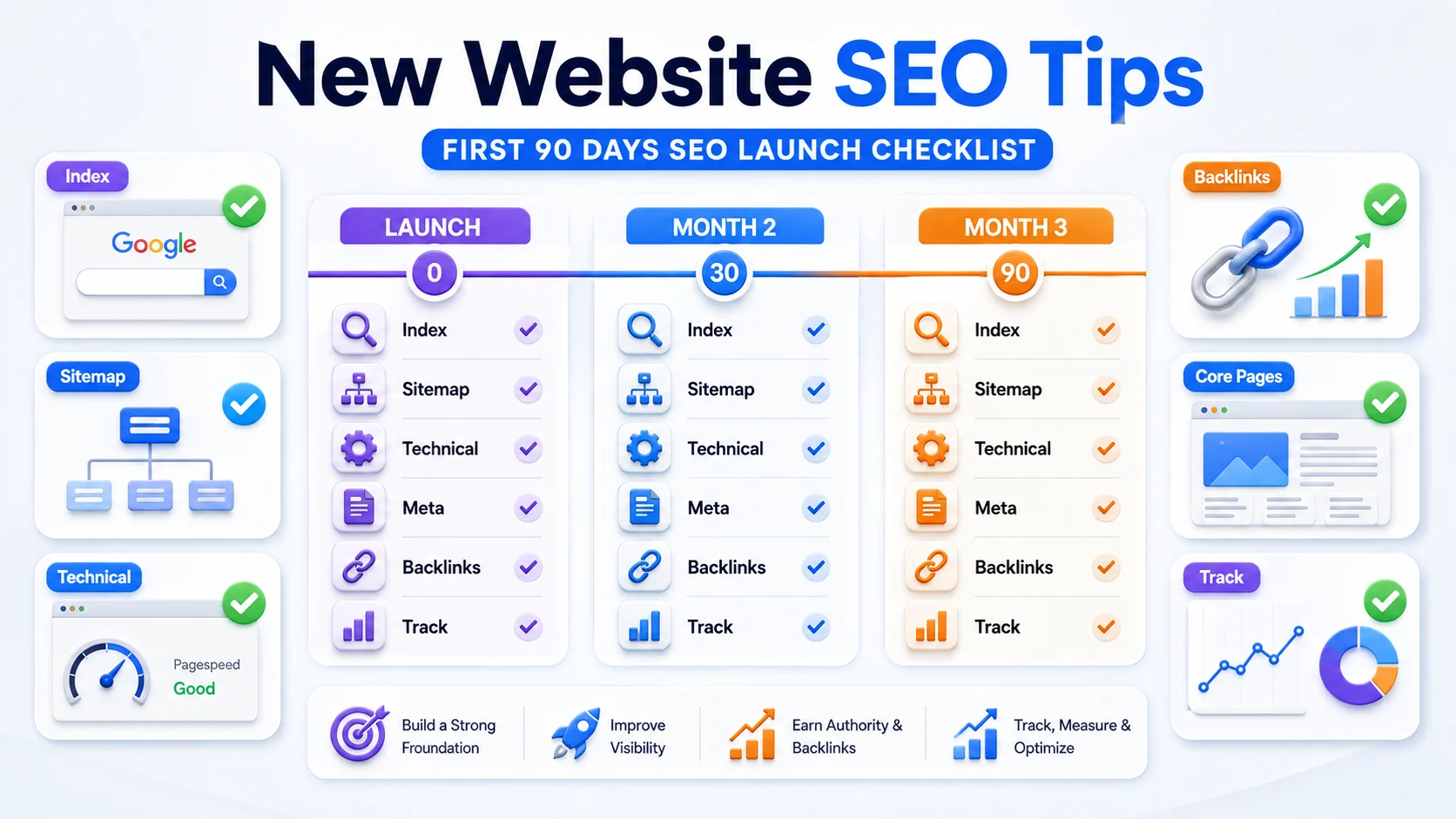
In this guide
- 1.Why New Websites Need a Different Playbook
- 2.New Website SEO Tips, In Order
- 3.Common New Website SEO Mistakes vs Better Approaches
- 4.Pros and Cons of Focusing Hard on SEO Early
- 5.Real-World Example
Why New Websites Need a Different Playbook
Advice written for established sites often assumes things a new site does not have: existing rankings to protect, historical data to analyze, or accumulated trust with Google.
A new website SEO plan has to focus on three things first:
- Getting discovered and indexed - Google needs to find your pages before anything else matters.
- Building initial trust signals - technical health, clear structure, and early backlinks help search engines evaluate the site.
- Avoiding early mistakes - the kind that are cheap to fix now and expensive to fix later.
This is why new website SEO should start with foundations, not a giant content calendar.
New Website SEO Tips, In Order
1. Get indexed first
Before worrying about rankings, make sure Google can find and index your site.
- Submit your XML sitemap through Google Search Console.
- Set up Bing Webmaster Tools too.
- Check that your robots.txt file is not accidentally blocking crawlers.
- Use the URL Inspection tool in Search Console to request indexing for key pages.
Use our Sitemap URL Counter and Robots.txt Validator to check the basics.
2. Set up clean technical foundations
A new site is the easiest time to get technical SEO right, before you have hundreds of pages to retrofit.
- Use a logical URL structure.
- Set up proper heading hierarchy.
- Add basic schema markup, at least Organization schema.
- Optimize images with descriptive alt text and compressed file sizes.
- Confirm mobile responsiveness across key pages.
Our Heading Structure Checker, Alt Text Checker, and Favicon Checker can help you review visible page quality signals.
3. Write title tags and meta descriptions with intent
Every indexed page needs a unique title tag and meta description written for the searcher, not just stuffed with keywords. A clear, specific title tag often outperforms a keyword-heavy one because it earns more clicks.
Use the Meta Title Length Checker and Meta Description Length Checker before publishing core pages.
4. Avoid duplicate content from day one
New sites often accidentally create duplicate content through www and non-www versions, HTTP and HTTPS versions, tag pages, or printer-friendly pages. Set canonical tags early so this never becomes a painful cleanup project.
Use the Canonical URL Checker to confirm your canonical setup.
5. Build your first backlinks through directories
A brand-new site has no reason yet for other sites to link to it organically. Submitting to relevant, well-moderated directories is usually one of the fastest ways to get your first legitimate backlinks without needing an existing audience or outreach list.
For more detail, read Does Directory Submission Still Work for SEO in 2026? and How to Choose the Right Directory Submission Service.
6. Publish core pages before blogging
Get your homepage, key product or service pages, About page, and Contact page fully optimized before pouring effort into blog content. These pages usually carry the most commercial intent.
7. Set up analytics and Search Console tracking
You cannot improve what you are not measuring. Connect analytics and Search Console on day one so you have baseline data to compare against later.
8. Do not chase too many keywords at once
New sites have no authority yet, so competing for broad, high-volume keywords right away rarely works. Start with specific, lower-competition long-tail keywords you can realistically rank for, then expand.
Common New Website SEO Mistakes vs Better Approaches
Here is a practical comparison for your first 90 days.
| Common mistake | Better approach | Why it matters |
|---|---|---|
| Skipping sitemap submission | Submit sitemap via Search Console on launch day | Speeds up discovery and indexing |
| Targeting broad competitive keywords | Start with long-tail, low-competition terms | New sites cannot usually compete for broad terms yet |
| No canonical tags set | Configure canonical tags from day one | Prevents duplicate content issues later |
| Ignoring page speed | Optimize images and scripts before launch | Improves search performance and user experience |
| Publishing blog content before core pages | Optimize homepage and product pages first | Core pages usually carry commercial intent |
| No early backlink plan | Submit to relevant directories in month one | Builds initial trust signals without needing an audience |
Pros and Cons of Focusing Hard on SEO Early
Pros
- Technical issues are cheaper to fix now than after the site has grown.
- Early indexing and backlinks start compounding sooner.
- Clean URL and content structure avoids painful retrofits later.
- Directory submissions can bring both links and early referral traffic.
Cons
- Results take time. A new site rarely sees meaningful organic traffic in the first month or two.
- It is easy to over-invest in content before the technical foundation is solid.
- Keyword competition can feel discouraging early, even when the strategy is correct.
- It requires discipline to focus on a few things well instead of everything at once.
Real-World Example
A new project management tool launched with zero backlinks and zero indexed pages.
In week one, the founder submitted the sitemap, fixed a robots.txt issue that accidentally blocked the blog subfolder, and added canonical tags.
In week two, they submitted the site to 15 relevant directories and fully optimized the homepage and three core product pages.
By week six, all key pages were indexed, several long-tail keywords started ranking, and the site had picked up its first dozen backlinks, mostly from directory listings.
The founder's takeaway: the unglamorous technical fixes in week one mattered just as much as anything published afterward.
Start your first 90 days with real discovery signals
SubmitWell helps new websites build early authority through manual directory submissions, relevant backlinks, and proof reports, so your SEO foundation starts cleaner.
See Plans - Starting at $35Frequently Asked Questions
How long does it take for a new website to start ranking on Google?
Most new sites see initial indexing within days to a couple of weeks, but meaningful rankings for competitive terms usually take 3 to 6 months of consistent work.
Should I submit my sitemap manually or wait for Google to find it?
Submit it manually through Google Search Console. Waiting for organic discovery can delay indexing by weeks, especially for a brand-new website with no backlinks.
Do I need backlinks before I start publishing content?
Not necessarily before, but starting content and backlinks around the same time works well. Backlinks help establish trust while content builds topical relevance.
What is the biggest SEO mistake new websites make?
Targeting broad, highly competitive keywords too early. A new site with no authority rarely outranks established competitors for those terms right away.
Is schema markup worth setting up on a brand-new site?
Yes. It is easier to implement correctly from the start than to retrofit across dozens of pages later, and it helps search engines understand your site faster.
How many pages should a new website launch with?
There is no fixed number. A focused set of well-optimized core pages, such as homepage, product or service pages, About, and Contact, is better than dozens of thin pages.
Can directory submissions help a brand-new site?
Yes, especially early on. Relevant directories can provide some of the first legitimate backlinks a new site receives without needing existing traffic or outreach relationships.
Should I worry about site speed before launch?
Yes. Site speed affects both search performance and user experience, and it is much easier to optimize before the site grows in complexity.
Useful tools for this guide
Start your first 90 days with real discovery signals
SubmitWell helps new websites build early authority through manual directory submissions, relevant backlinks, and proof reports, so your SEO foundation starts cleaner.
See Plans & PricingOne-time payment. No subscription.