
What Is llms.txt and Should Startup Websites Use It?
AI search has changed how founders think about website visibility. It is no longer enough to only ask whether Google can crawl your site. Founders are also asking whether AI assistants, answer engines, and language models can understand what the site does, which pages matter, and which facts should be trusted. That is where llms.txt comes in. It is a simple text file that gives AI systems a clean, human-written map of your website. It is not a magic ranking factor, and it will not replace technical SEO, backlinks, or useful content. But for startup websites that want to be easier for AI tools to understand, it is a smart low-effort addition.
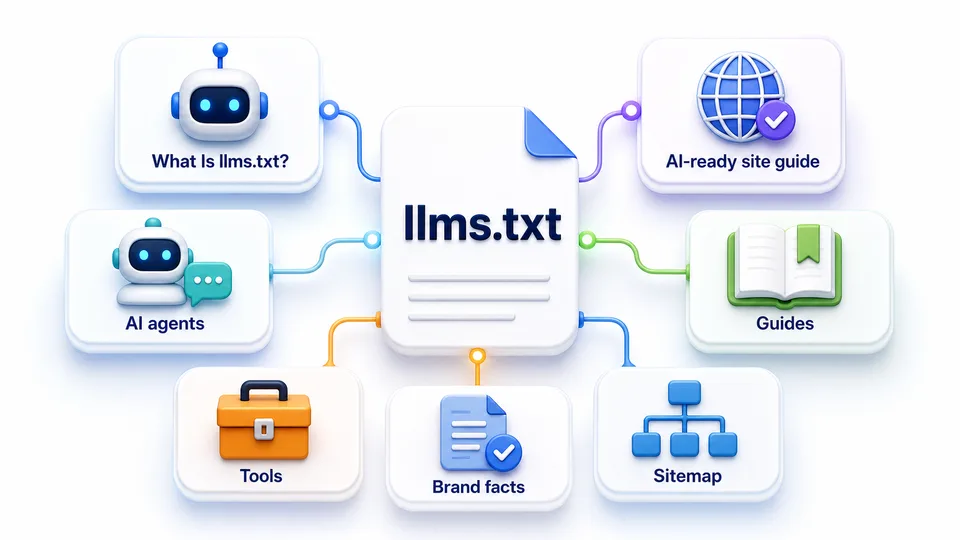
In this guide
- 1.In This Guide
- 2.What Is llms.txt?
- 3.Why llms.txt Matters for Startup Websites
- 4.llms.txt vs robots.txt vs sitemap.xml
- 5.What to Include in llms.txt
- 6.What Not to Include
- 7.A Simple Startup llms.txt Structure
- 8.Should Startup Websites Use llms.txt?
- 9.How SubmitWell Uses llms.txt
In This Guide
- What Is llms.txt?
- Why llms.txt Matters for Startup Websites
- llms.txt vs robots.txt vs sitemap.xml
- What to Include in an llms.txt File
- What Not to Include
- A Simple Startup llms.txt Structure
- Should You Add It Now?
What Is llms.txt?
llms.txt is a plain Markdown file usually placed at the root of a website, for example https://example.com/llms.txt. Its job is to explain the website in a concise, structured way for large language models and AI agents.
Think of it as an AI-readable site guide. A good llms.txt file tells AI systems what your company does, which pages are important, what products or services you offer, and where to find deeper reference pages.
It is different from a normal landing page because it removes visual layout, navigation clutter, scripts, popups, and unnecessary copy. It gives AI systems the clean version of your site story.
Why llms.txt Matters for Startup Websites
For a startup, clear positioning matters everywhere: your homepage, directory profiles, launch pages, social previews, and now AI discovery files.
When someone asks an AI tool for recommendations, comparisons, alternatives, or startup tools in a category, the AI system needs to understand what each website actually does. If your site has scattered messaging, thin pages, or unclear navigation, that understanding can be weaker.
llms.txt helps by giving AI systems a direct summary of your brand and your most useful URLs. It can support:
- Clearer brand understanding
- Better product context
- Easier discovery of guides and tools
- Cleaner reference material for AI answer engines
- More consistent wording around what your startup does
This does not mean llms.txt guarantees AI citations. It simply gives crawlers and AI systems a better source to read if they choose to use it.
llms.txt vs robots.txt vs sitemap.xml
These files work together, but they do different jobs.
robots.txt tells crawlers which parts of your site they can or cannot access. It is mainly a crawl control file.
sitemap.xml lists important URLs so search engines can discover pages more easily. It is mainly a URL discovery file.
llms.txt explains your site in plain language for AI systems. It is mainly a context and reference file.
A startup that wants strong technical SEO should not choose only one. The better setup is to have all three: robots.txt for crawl rules, sitemap.xml for URL discovery, and llms.txt for AI-readable context.
What to Include in llms.txt
A useful llms.txt file should be short, structured, and factual. The goal is not to stuff keywords. The goal is to help AI systems understand your site correctly.
For a startup website, include:
- A one-paragraph summary of what the startup does
- The product category and target users
- Main service or product pages
- Pricing or plan pages if public
- Important guides, resources, or documentation
- Free tools or interactive resources
- Contact or support links
- Machine-readable files like sitemap, image sitemap, RSS feed, and full reference files
If your startup has many guides, tools, or programmatic pages, you can also link to a longer llms-full.txt file with deeper reference details.
What Not to Include
Do not treat llms.txt like a keyword stuffing page. AI systems are looking for clarity, not repeated phrases.
Avoid:
- Fake claims about results
- Outdated pricing or features
- Long marketing fluff
- Private customer information
- Internal-only URLs
- Boilerplate copied from every page
- Links to weak or empty pages
The safest rule is simple: only include facts you would be comfortable showing publicly on your homepage, pricing page, or help docs.
A Simple Startup llms.txt Structure
A clean startup llms.txt can follow this structure:
1. Site name and one-sentence description 2. Short summary of who the product is for 3. Core product or service pages 4. Free tools and useful resources 5. Best guides or documentation 6. Pricing and policy pages 7. Contact information 8. Links to sitemap.xml, image-sitemap.xml, feed.xml, and llms-full.txt if available
That structure is enough for most early-stage websites. You do not need to overbuild it on day one.
Should Startup Websites Use llms.txt?
Yes, but with the right expectation.
If your startup already has a live website, clear service pages, useful guides, and basic SEO files, adding llms.txt is worth doing. It is fast, lightweight, and helps document your site for AI systems.
If your website is still a one-page placeholder with no real content, fix the basics first. Write clearer homepage copy, publish useful pages, add a sitemap, set up metadata, and make sure your site can be crawled.
llms.txt works best when it points to real substance.
How SubmitWell Uses llms.txt
SubmitWell uses llms.txt as part of a broader AI and search discovery setup. The site also includes structured data, an XML sitemap, image sitemap, RSS feed, optimized guide pages, and internal links across startup SEO topics.
That combination matters more than any single file. AI visibility is built from clear content, consistent facts, crawlable pages, trustworthy mentions, and useful resources.
For startups, that is the same reason directory submissions still matter. They create external references, branded profiles, and backlink signals that help search engines and AI systems understand that the product exists across the web.
Make your startup easier to understand across search and AI
SubmitWell helps founders build real directory profiles, backlink proof, and external trust signals that support discoverability beyond your own website.
See Plans - Starting at $35Frequently Asked Questions
Does llms.txt improve Google rankings?
There is no confirmed evidence that llms.txt directly improves Google rankings. Its value is in making your site easier for AI systems to understand, while traditional SEO still depends on content quality, crawlability, links, and user value.
Is llms.txt the same as robots.txt?
No. robots.txt controls crawler access. llms.txt explains your website to AI systems in a concise Markdown format. They serve different purposes and can exist together.
Should every startup have an llms.txt file?
Most startups can benefit from one once the site has real pages, clear positioning, and useful resources. It is especially useful for SaaS, AI tools, developer tools, and content-heavy startup websites.
What should a startup include in llms.txt?
Include a factual company summary, core pages, product or service pages, tools, guides, pricing or policy pages, contact details, and links to your sitemap, RSS feed, and full reference file if available.
Can llms.txt help with AI search visibility?
It can support AI visibility by giving AI systems clearer context, but it does not guarantee citations or recommendations. It works best alongside structured data, strong content, clean metadata, and external trust signals.
How long should llms.txt be?
Keep the main llms.txt short enough to scan quickly. If you need deeper coverage, link to a separate llms-full.txt file with more detailed reference information.
Useful tools for this guide
Related Resources
Make your startup easier to understand across search and AI
SubmitWell helps founders build real directory profiles, backlink proof, and external trust signals that support discoverability beyond your own website.
See Plans & PricingOne-time payment. No subscription.