
What to Expect From a Professional Startup Directory Submission Service
You have built your product. Now you need people to find it. One of the oldest and most reliable ways to get early visibility is to list your startup in online directories. Doing that well takes time, and many founders hand it to a professional service. This guide explains what that service should actually do, what you should receive, what not to expect, and how to judge whether the work helped.
In this guide
- 1.What Is a Startup Directory Submission Service?
- 2.Why Founders Use These Services
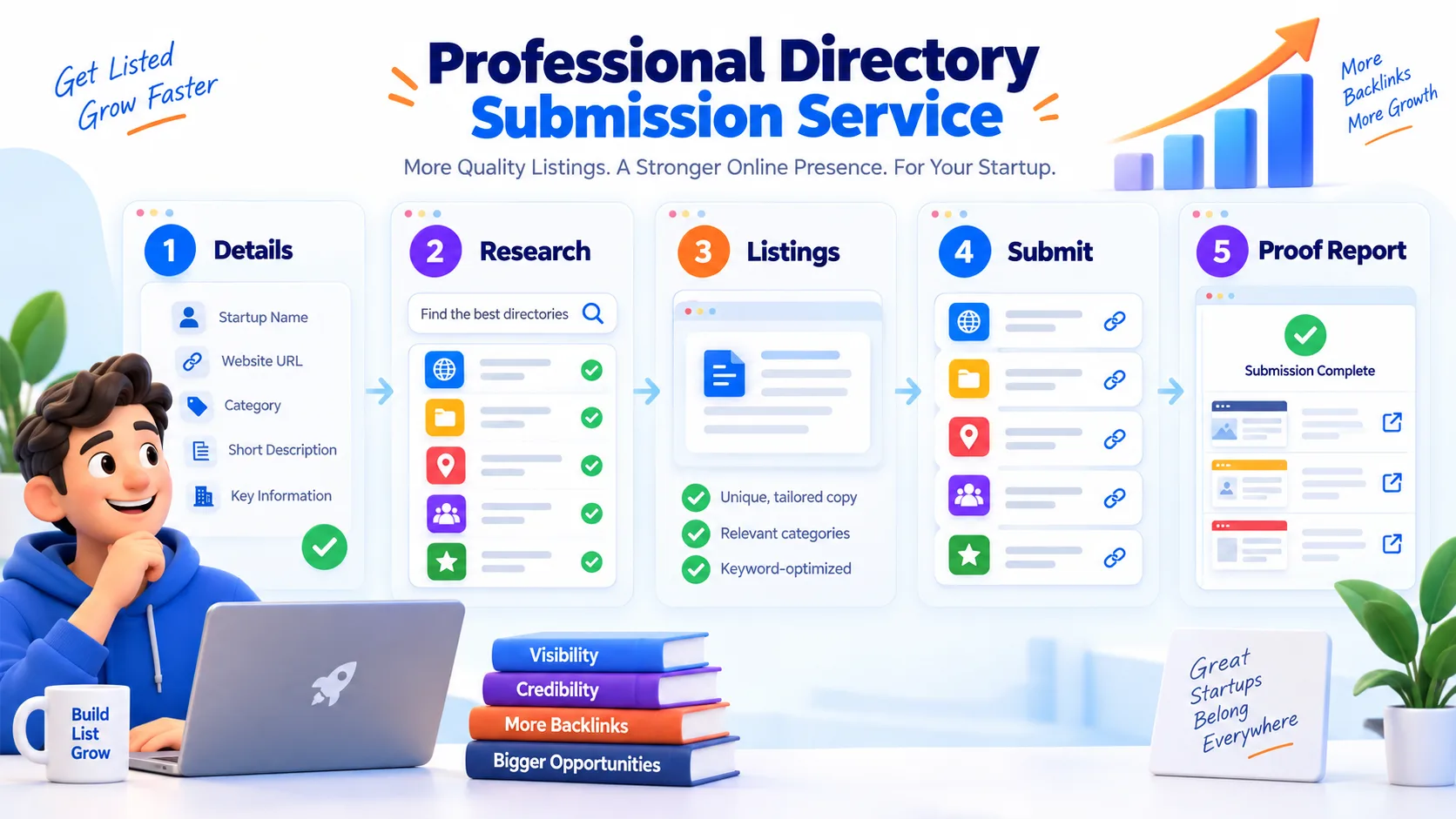
- 3.Step-by-Step: What the Process Should Look Like
- 4.Manual vs Automated Directory Submission
- 5.What a Good Service Should Deliver
- 6.What You Should Not Expect
- 7.Pros and Cons of Using a Professional Service
- 8.A Realistic Example
- 9.How to Measure Results
- 10.Red Flags to Watch For
- 11.How to Choose the Right Provider
- 12.Final Thoughts
What Is a Startup Directory Submission Service?
A [startup directory submission service](/) lists your product on websites where people discover new tools and companies. These can include startup directories, SaaS listing sites, product launch platforms, and niche lists for your industry.
The service does the work for you: finding suitable directories, preparing your listing details, submitting the product, and reporting back. A good service saves hours of repetitive form-filling and helps you avoid low-quality sites that add little value.
Some services use software to blast your link to hundreds of sites at once. Others do the work manually. That difference matters because directory quality, listing copy, and approval handling affect whether the work creates useful visibility or just noise.
Why Founders Use These Services
Directory listings help in three practical ways:
Backlinks. A link from a relevant, trusted directory can help search engines discover your website and understand that it is a real product.
Discovery. Buyers, journalists, investors, and early adopters often browse directories to find new products.
Brand signals. Consistent listings across reputable sites make a startup look more established than a single isolated homepage.
A professional service does not replace product quality, technical SEO, or useful content. It gives a new site a stronger discovery base to build on.
Step-by-Step: What the Process Should Look Like
Most professional services follow a similar path.
1. Onboarding and information gathering
You provide the basics: product name, website, short and long description, category, logo, screenshots, founder details, and social links. A good service checks for missing assets, inconsistent naming, and weak descriptions before submitting anything.
2. Directory research and selection
The service chooses directories that fit your product. A SaaS tool, AI product, developer tool, and local business should not all receive the same directory list. Good selection considers relevance, traffic, domain quality, moderation, and whether the directory is maintained.
3. Listing creation
Every directory has its own rules, categories, and character limits. Good listing work adapts your copy for each site instead of pasting the exact same paragraph everywhere.
4. Manual submission
This is the actual work: creating accounts, filling forms, uploading assets, confirming emails, and handling directories that require review, reciprocal links, or payment.
5. Proof reporting
At the end, you should receive a report that is easy to verify: directory names, submitted URLs or live listing URLs when available, and proof such as screenshots or listing links.
Manual vs Automated Directory Submission
This is the biggest difference to understand before you buy.
| Feature | Manual submission | Automated bulk submission |
|---|---|---|
| Who does the work | A real person | Software or scripts |
| Directory quality | Chosen with care | Often a giant mixed list |
| Listing copy | Adjusted per directory | Usually identical everywhere |
| Approval rate | Usually higher | Often lower |
| Spam risk | Lower when directories are vetted | Higher if the list is weak |
| Speed | Slower | Faster |
| Best for | Startups that want lasting value | Very tight budgets with low expectations |
What a Good Service Should Deliver
Use this checklist when comparing providers:
- A clear scope, including how many directories are included
- Relevant directories, not just any site that accepts submissions
- Human-written or carefully adapted listings
- Honest handling of paid directories and extra fees
- A report with submitted links, live links when available, and proof
- Realistic timelines for submission and approval
- Support from someone who can answer questions
- No fake ranking guarantees
If you want a deeper buying checklist, read How to Choose the Right Directory Submission Service.
What You Should Not Expect
Setting the right expectations protects you from disappointment and bad sellers.
Do not expect instant rankings. Directory links help over time. They are one part of SEO, not a magic switch.
Do not expect a flood of customers. Some directories send referral visitors, but much of the value is early discovery, brand presence, and backlink signals.
Do not expect 100% approval. Directory owners control their own review process.
Do not expect control over every future edit. A directory can update, remove, or change a listing later.
Do not expect links to rescue a weak site. Directory submissions work best alongside a clear website, useful content, and a good product. Google's SEO starter guide is a useful baseline for the site-side work that should support link building.
Pros and Cons of Using a Professional Service
Pros
- Saves hours of repetitive submission work
- Usually produces better directory selection than a beginner list
- Keeps listings more consistent across the web
- Lets founders focus on product and customers
- Gives you a report instead of scattered notes
Cons
- Manual work costs more than bulk tools
- Results take weeks or months to show
- You give up some control over small submission details
- Quality varies heavily between providers
- Some directories may still take time to review or approve your listing
A Realistic Example
Imagine a solo founder launching a project management tool for freelancers. The site is new, has almost no backlinks, and does not show up for much beyond the brand name.
The founder tries submitting manually for a week, completes a few forms, loses track of which sites were done, and stops. Then she uses a manual submission service. A couple of weeks later, she receives a report showing the directories submitted, available listing links, and screenshot proof.
Nothing dramatic happens overnight. But over the next few months, the site has more branded search presence, a few referral visits from directories, and a cleaner base of referring domains. That foundation makes later content, outreach, and comparison pages work better.
How to Measure Results
Do not judge the work on day one. Check these signals after a few weeks and again after a few months:
- Live listings: how many approved listings are working?
- Referring domains: are new directory links appearing in SEO tools?
- Branded search: are more people searching for your product name?
- Referral traffic: are directories sending visits in analytics?
- Indexing: are important directory pages discoverable in search?
Track these in a simple spreadsheet. It is more useful than staring at one metric like Domain Rating every day.
Red Flags to Watch For
Be careful if a provider offers:
- Guaranteed rankings or guaranteed traffic
- Thousands of submissions for a suspiciously low price
- No sample report or no way to verify links
- No explanation of how directories are selected
- No human contact or support
- Vague answers about directory fees
- Link tactics that appear to violate Google's spam policies
The goal is not to create the largest possible link count. The goal is to earn relevant, checkable listings that make sense for your startup.
How to Choose the Right Provider
Ask direct questions before you pay:
- Is the submission manual or automated?
- How do you choose directories for my niche?
- Will I get a report with live or submitted URLs?
- What proof will I receive after submission?
- Are directory fees included or extra?
- What is a realistic timeline?
Clear answers are a good sign. Vague answers are not. For more context, compare manual vs automated directory submission and Submit Manually or Use a Service?.
Final Thoughts
A professional startup directory submission service should make your life easier, not more confusing. Expect real people, relevant directories, careful listing work, and a report you can verify. Do not expect overnight rankings or magic.
Used the right way, directory listings are a solid, lower-risk step in early SEO. They work best alongside good content, a fast website, and a clear product message. Founders and SaaS creators who want this handled carefully can look at [SubmitWell's manual submission service](/) and decide whether it fits their stage.
Get professional directory submissions without the busywork
SubmitWell handles manual startup directory submissions, listing copy, directory selection, and proof reporting so founders can build visibility without chasing every form themselves.
See Plans - Starting at $35Frequently Asked Questions
What is a startup directory submission service?
It is a service that lists your startup on relevant directories and listing sites. The goal is to earn backlinks, improve visibility, and build credibility.
How long does directory submission take?
The submission work itself can take days to a couple of weeks. Approvals depend on each directory and can take longer, so plan for a few weeks.
Will directory submissions improve my Google rankings?
They can help as part of a wider SEO plan. Quality directories give you useful backlinks and brand signals, but they do not guarantee rankings.
Is manual submission better than automated submission?
For most startups, yes. Manual work means better directory choices and more natural listings, which lowers the risk of spam signals.
Can directory submissions hurt my SEO?
Yes, if they come from low-quality or spammy sites. That is why directory selection matters more than the number of links.
What should be in a submission report?
A good report lists each directory, submitted URLs or live URLs when available, and proof of the submission. You should be able to open and check the links that are live.
Do I need to pay directory fees on top of the service price?
It depends on the provider. Some directories charge fees, so ask upfront whether they are included or billed separately.
How do I know if the service worked?
Check live listings, new referring domains, branded search growth, and referral traffic over a few months. Steady, small gains are normal.
Useful tools for this guide
Get professional directory submissions without the busywork
SubmitWell handles manual startup directory submissions, listing copy, directory selection, and proof reporting so founders can build visibility without chasing every form themselves.
See Plans & PricingOne-time payment. No subscription.