
Submit Manually or Use a Service? Comparing DIY Directory Submissions With Done-For-You Options
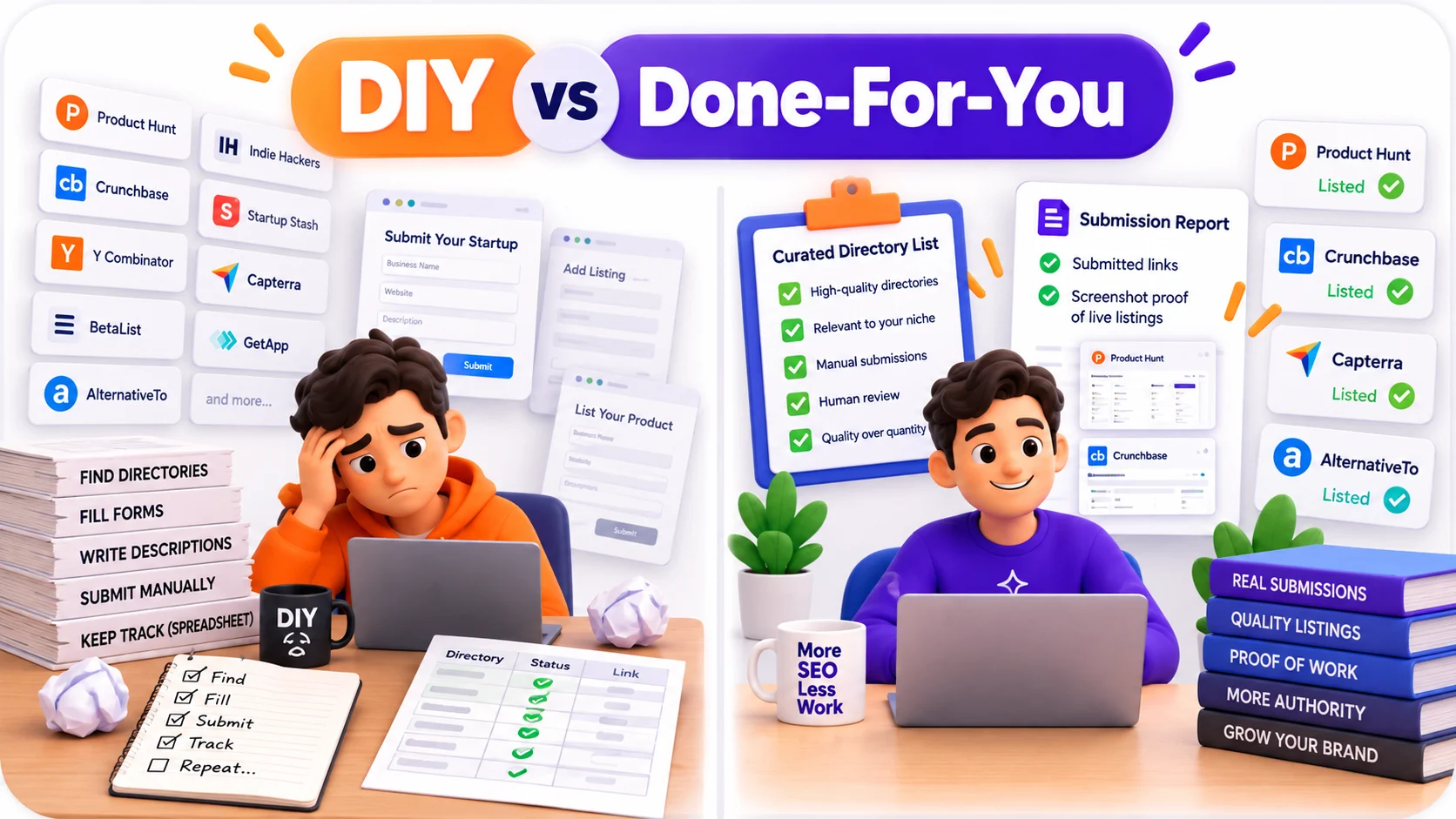
If you just launched a SaaS product or digital tool, someone has probably told you to submit it to directories. It sounds simple: find a list, fill out forms, get backlinks. But once you start, you realize the real work is research, writing, accounts, categories, screenshots, follow-ups, and proof. This guide compares the two practical paths: doing directory submissions yourself or using a done-for-you service.
In this guide
- 1.Why Directory Submissions Still Matter in 2026
- 2.The DIY Manual Submission Checklist
- 3.Common Mistakes to Avoid
- 4.How to Track Acceptance and Backlinks
- 5.Example Timeline for 50 to 200 Directories
- 6.DIY vs Done-For-You Directory Submissions
- 7.Pros and Cons of Each Approach
- 8.Where SubmitWell Fits
Why Directory Submissions Still Matter in 2026
Directory submissions are not magic SEO. They work best as an early trust-building layer for new websites that have few links, few mentions, and little search history.
Good directory submissions can help with:
- Early backlinks from relevant discovery sites, SaaS directories, startup lists, and launch platforms.
- Brand mentions that help search engines and AI systems see your startup in more places.
- Referral traffic from people browsing tools in your category.
- Entity clarity because repeated, consistent descriptions make your brand easier to understand.
- Faster discovery when directory pages get crawled and link back to your site.
The quality difference matters. A focused submission to relevant directories is very different from an automated blast to random low-quality sites. For the broader SEO view, read Does Directory Submission Still Work for SEO in 2026? and How to Choose the Right Directory Submission Service.
The DIY Manual Submission Checklist
If you choose to do submissions yourself, prepare everything before opening the first form.
1. Prepare your assets
- Short description, usually 25 to 30 words
- Long description, usually 150 to 300 words
- Tagline
- 512x512 logo
- 3 to 5 product screenshots
- Canonical website URL
- Category and tags
- Founder name, company name, and support email
You can speed this up with our Directory Description Generator, Startup Tagline Generator, and Canonical URL Checker.
2. Build your directory list
Mix high-authority general directories, niche directories, startup directories, indie hacker communities, SaaS directories, AI tool directories, and product launch platforms. A focused starter list might be 50 directories. A wider campaign may be 100 to 200.
3. Choose the right category
Bad category choices reduce approval rates and weaken referral traffic. If your product is a developer tool, do not force it into generic productivity. If it is an AI tool, be specific about whether it is writing, design, coding, analytics, or automation.
4. Rewrite descriptions for each directory
Do not paste the same generic paragraph everywhere. Keep the core positioning consistent, but adjust length, angle, and category language based on the directory.
5. Submit and record everything
Keep a spreadsheet with directory name, URL, account email, submission date, status, live listing URL, dofollow or nofollow note, and follow-up date. This is DIY tracking, not a SubmitWell dashboard.
6. Follow up
Some listings go live instantly. Others sit in review. Revisit pending submissions after one to two weeks and fix weak descriptions or missing assets when needed.
Common Mistakes to Avoid
The biggest directory submission mistakes are usually operational, not strategic.
- Submitting to irrelevant directories just because they are on a big list
- Using inconsistent names, URLs, taglines, and descriptions across platforms
- Ignoring whether links are dofollow, nofollow, redirected, or hidden
- Choosing broad categories that do not match the product
- Using weak screenshots or missing logos
- Forgetting to record where you submitted
- Submitting everything in one rushed day with copied descriptions
- Treating directory submission as a replacement for technical SEO and useful content
Directory submissions work better when they support the rest of your SEO foundation: sitemap, robots.txt, title tags, canonical tags, internal links, and clear content. Our Free SEO Audit Checklist for Startups covers that full setup.
How to Track Acceptance and Backlinks
If you are doing this yourself, simple tracking is enough. You do not need a complex CRM for the submission work.
Track:
- Directory submitted
- Submission date
- Account email used
- Status: submitted, live, rejected, pending
- Live listing URL
- Link type: dofollow, nofollow, redirected, or unclear
- Notes about category or description changes
- Follow-up date
Then check backlinks monthly with tools like Ahrefs, Semrush, Ubersuggest, or Bing Webmaster Tools. Also watch referral traffic in analytics. Some directories help SEO slowly; others send users directly. Both are useful, but they should be measured separately.
Example Timeline for 50 to 200 Directories
A manual submission campaign is usually easier when spread across several weeks instead of rushed in one sitting.
| Timing | Activity |
|---|---|
| Week 1 | Prepare logos, screenshots, descriptions, categories, and a submission spreadsheet |
| Week 2 | Submit to the top 20 high-authority startup and SaaS directories |
| Week 3 | Submit to 30 to 50 niche, category-specific, and founder-focused directories |
| Week 4 | Submit remaining startup and indie directories, then follow up on pending submissions |
| Weeks 5 to 6 | Review rejected or pending listings, improve descriptions, and correct category choices |
| Weeks 7 to 8 | Check live links, review referral traffic, and run a backlink audit |
A 50-directory DIY run can be manageable for a founder. A 150 to 200 directory push often becomes a part-time operations project.
DIY vs Done-For-You Directory Submissions
The right choice depends on whether your constraint is money, time, attention, or execution quality.
| Factor | DIY manual submission | Done-for-you service |
|---|---|---|
| Time investment | Often 20 to 40+ hours over several weeks | A few hours preparing startup details and reviewing delivery proof |
| Cost | Mostly your time | Paid, usually based on directory count |
| Directory research | You find and vet every site yourself | Uses a pre-vetted list chosen for relevance and quality |
| Description quality | Depends on your patience and consistency | More standardized across submissions |
| Proof | You maintain your own spreadsheet and screenshots | You receive submitted links and screenshot proof |
| Risk | Higher if you use random lists or low-quality sites | Lower when the service avoids spammy automated blasts |
| Best for | Founders with more time than budget | Founders who want to save time and avoid repetitive submission work |
Pros and Cons of Each Approach
DIY pros
- Lowest cash cost
- You learn which directories exist in your market
- You control every description and category choice
- Good option for very early founders with more time than budget
DIY cons
- Repetitive and easy to abandon halfway
- Directory research takes longer than expected
- Tracking approvals and live links becomes messy
- Mistakes can reduce acceptance rates
Done-for-you pros
- Saves founder time
- Uses a curated directory process
- Keeps submissions manual instead of bot-driven
- Delivers links and screenshot proof after work is completed
Done-for-you cons
- Costs more than doing it yourself
- You still need to provide accurate startup assets
- Third-party directories control approval timing
- It should support your SEO strategy, not replace it entirely
Where SubmitWell Fits
SubmitWell is for founders who want the directory submission work handled manually without pretending it is a full SEO agency, a live tracking dashboard, or an automated backlink machine.
The useful part is operational: curated directory selection, manual submissions, consistent descriptions, and a delivery report with submitted links and screenshot proof. You can still monitor accepted listings and backlink changes over time using your own analytics, Search Console, Ahrefs, Semrush, or another SEO tool.
If you want to learn the broader evaluation criteria before paying anyone, read How to Choose the Right Directory Submission Service. If you are still deciding whether directory submission fits your SEO plan, start with What Is Directory Submission?.
Choose the directory submission path that fits your time
SubmitWell handles manual directory submissions for founders who want curated directories, consistent descriptions, and delivery proof without spending weeks on repetitive forms.
See Plans - Starting at $35Frequently Asked Questions
Are directory submissions still good for SEO in 2026?
Yes, when they are relevant, manual, and quality-focused. Random automated submissions to low-quality sites are far less useful and can make your backlink profile look weak.
How many directories should a new SaaS product submit to?
A new SaaS product can start with 50 relevant directories. Stronger campaigns may target 100 to 200, but quality and relevance matter more than raw count.
Do nofollow links from directories still help?
Nofollow links may not pass traditional link equity the same way dofollow links do, but they can still help with discovery, referral traffic, brand mentions, and a natural-looking backlink profile.
How long does manual directory submission take?
A focused 50-directory run can take several long work sessions. A 100 to 200 directory campaign can take 20 to 40+ hours when you include research, descriptions, accounts, uploads, follow-ups, and proof tracking.
What is the biggest mistake founders make with directory submissions?
The biggest mistake is using a random list and copying the same weak description everywhere. Relevance, category fit, and description quality affect both approval rates and the value of each listing.
Should I use the same description on every directory?
No. Keep your core positioning consistent, but adapt the length, category wording, and benefit angle for each directory. This improves acceptance and makes listings look more natural.
How do I know if a directory submission service is worth paying for?
Look for manual submission, clear directory quality standards, realistic claims, submitted links, screenshot proof, and no promise that every third-party directory will approve instantly.
Can I mix DIY and a done-for-you service?
Yes. Many founders handle a few niche directories themselves and use a service for the repetitive broader submission work.
Useful tools for this guide
Choose the directory submission path that fits your time
SubmitWell handles manual directory submissions for founders who want curated directories, consistent descriptions, and delivery proof without spending weeks on repetitive forms.
See Plans & PricingOne-time payment. No subscription.