
Why Google Updates Are Important for SEO
If you've ever watched your traffic drop overnight for no obvious reason, there's a good chance a Google update was the cause. Google changes its search algorithm thousands of times a year, and while most of these changes are small, a handful of major updates can reshape entire industries' search rankings within days. For founders and indie hackers, understanding why these updates matter isn't optional. Your website's visibility, your leads, and often your entire growth channel depend on staying aligned with how Google decides what deserves to rank. This guide breaks down what Google updates actually are, why they matter so much, and how to build an SEO strategy that survives them.
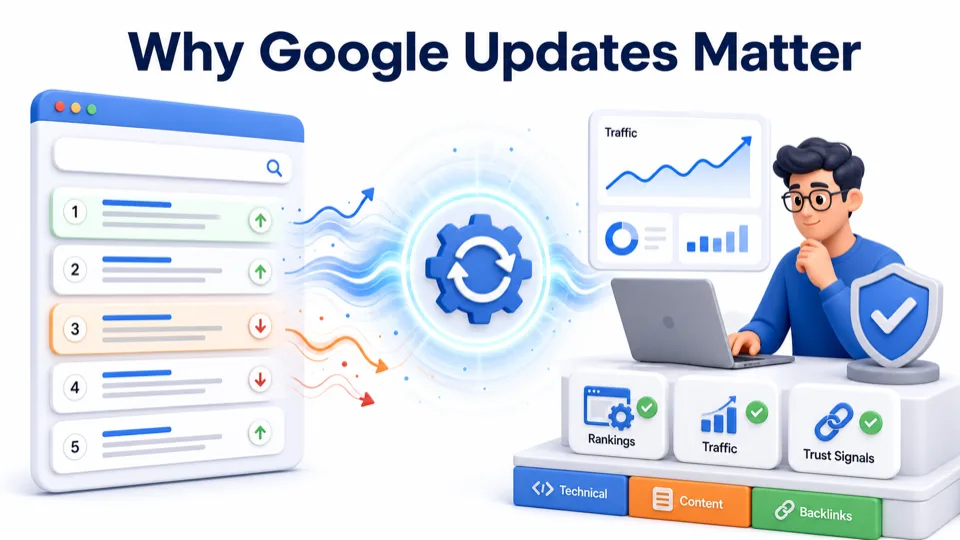
In this guide
- 1.In This Guide
- 2.What Is a Google Update?
- 3.Why Google Updates Matter for SEO
- 4.Types of Google Updates You Should Know
- 5.How to Know If an Update Hit Your Site
- 6.Building an Update-Resistant SEO Strategy
- 7.Real-World Examples
- 8.Stay Ahead of the Next Update
In This Guide
- What Is a Google Update?
- Why Google Updates Matter for SEO
- Types of Google Updates You Should Know
- How to Know If an Update Hit Your Site
- Building an Update-Resistant SEO Strategy
- Real-World Examples
- Frequently Asked Questions
What Is a Google Update?
A Google update is a change to the algorithm Google uses to rank web pages in search results. Google runs thousands of small tweaks every year, but it also rolls out large, named updates several times annually, things like Core Updates, Helpful Content Updates, and Spam Updates.
Small updates usually go unnoticed. Big updates can move rankings dramatically, sometimes within 24 to 48 hours of rollout. A page ranking on page one on Monday can drop to page four by Thursday, and a competitor's page can take its place, without either site changing a single word of content.
Google doesn't do this to punish sites. The stated goal, repeated in Google's own documentation, is to better match search results with what users actually find helpful, trustworthy, and relevant. Whether every update achieves that perfectly is debatable, but the intent shapes how you should think about SEO going forward.
Why Google Updates Matter for SEO
Here's the part that trips up a lot of early-stage founders: SEO isn't a one-time setup. It's an ongoing relationship with a search engine that keeps changing its own rules.
Rankings are not permanent. A page that ranks well today can lose that position after an update, even without any changes on your end. Google is constantly re-evaluating the entire web against new criteria.
Traffic and revenue are directly tied to visibility. For most startups, organic search is either the top or second-largest acquisition channel. A single update that drops your rankings can mean a real, measurable drop in signups, demo requests, or sales, sometimes 20 to 60 percent in a matter of days for sites that were over-relying on outdated tactics.
Updates reward genuine quality over shortcuts. Many major updates specifically target manipulative tactics: thin content, keyword stuffing, spammy backlinks, and AI-generated content with no real value. Sites built on shortcuts tend to get hit hardest, while sites built on genuine expertise and useful content tend to recover faster or aren't affected at all.
They reflect how users actually search. Google updates increasingly account for search intent, not just keyword matching. A page stuffed with keywords but lacking real answers will lose to a shorter, clearer page that actually solves the searcher's problem. This is why understanding updates helps you write better content, not just "SEO-friendly" content.
Ignoring updates compounds risk over time. If you build your entire SEO strategy around what worked two years ago, you're stacking risk. Each new update is a chance for outdated tactics to get flagged. Staying current isn't about chasing every algorithm change, it's about building a site that would hold up under scrutiny regardless of which update rolls out next.
Types of Google Updates You Should Know
Not all updates are the same. Understanding the categories helps you diagnose what's actually happening when your rankings shift.
Core Updates are broad changes to Google's overall ranking systems, usually rolled out several times a year. These affect a wide range of sites across every industry and typically take one to two weeks to fully roll out. There's rarely one specific fix, recovery usually means broadly improving content quality and site trustworthiness.
Helpful Content Updates target content written primarily to rank in search rather than to genuinely help a reader. Thin blog posts, AI-generated filler, and content that doesn't reflect real experience or expertise are common targets.
Spam Updates go after manipulative tactics directly: scraped content, cloaking, link schemes, and auto-generated pages with no real value.
Link Spam Updates specifically target unnatural backlink patterns, including paid links that don't disclose their nature and link networks built purely to manipulate rankings.
Product Review Updates, now folded into broader quality systems, originally targeted thin affiliate content that didn't show real hands-on testing or comparison depth.
Most founders don't need to memorize every update by name. What matters is recognizing the pattern: Google is consistently pushing toward genuine expertise, real usefulness, and trustworthy signals, and consistently pushing away from shortcuts.
How to Know If an Update Hit Your Site
If your traffic drops suddenly, don't panic, but do investigate methodically.
Check the date against known update rollouts. Google announces major updates on its Search Status Dashboard and via the Google Search Central account on X. Cross-reference your traffic drop date with any announced rollout window.
Look at Google Search Console. Compare click and impression trends over the past 90 days. A sharp, sitewide drop that lines up with an update date is a strong signal. A gradual decline over weeks is more likely a content or technical issue unrelated to a specific update.
Segment by page type. Did all pages drop equally, or just a specific category, like thin product pages or old blog posts? This tells you whether the update targeted a specific weakness.
Check competitors in the same niche. If competitors also dropped, it's likely an industry-wide algorithm shift. If they held steady or grew while you dropped, it's more likely a site-specific quality signal.
Rule out technical issues first. Before blaming an update, confirm there's no broken redirect, accidental noindex tag, or server outage that coincidentally happened around the same time.
Building an Update-Resistant SEO Strategy
You can't predict every future update, but you can build a site that's less vulnerable to them.
Pros of an update-resistant strategy
- Rankings recover faster after algorithm shifts because the foundation is genuinely solid
- Less time spent reacting to every rumor of a new update
- Content built on real expertise tends to compound in value over time rather than decay
- Backlink profiles built through legitimate means, like manual directory submissions and earned media, are far less likely to be discounted by spam updates
Cons and trade-offs
- Building genuine authority takes longer than quick-win tactics
- Requires ongoing investment in content quality, not a one-time setup
- No strategy is 100% immune, even strong sites can see temporary dips during major core updates
The practical takeaway: focus on demonstrable expertise, real user value, and legitimate authority-building rather than shortcuts. This is exactly why manual, verifiable backlink strategies tend to outperform automated ones over time. Services like SubmitWell that handle real, manual directory submissions build the kind of transparent, verifiable backlink trail that holds up well under scrutiny, compared to bulk automated submissions that can look unnatural to Google's spam systems.
Real-World Examples
Example 1: A SaaS blog recovers after a Helpful Content Update. A project management SaaS company had dozens of thin, AI-generated blog posts targeting long-tail keywords. After a Helpful Content Update, traffic to those posts dropped by roughly 40%. The team consolidated 30 thin posts into 8 comprehensive guides written with real product screenshots and specific use cases. Within the next core update cycle, rankings for the consolidated pages recovered and exceeded previous levels.
Example 2: An e-commerce site hit by a Link Spam Update. A mid-sized e-commerce store had been buying links from a private blog network to boost rankings for competitive keywords. A Link Spam Update discounted a large portion of those links overnight, and rankings for their top pages dropped out of the top 20. Recovery required months of building legitimate backlinks through partnerships, guest content, and directory listings, a reminder that manipulative shortcuts create long-term risk, not lasting gains.
Example 3: An early-stage startup that stayed stable. A newly launched developer tools startup focused from day one on manual directory submissions, genuine guest posts, and detailed comparison content. When a major core update rolled out six months after launch, competitor forums reported significant volatility, but this startup's rankings stayed flat. Their backlink profile was small but entirely legitimate, and their content answered real user questions in depth, exactly the kind of signals Google's updates tend to reward.
Stay Ahead of the Next Update
The safest long-term SEO strategy is the one that doesn't depend on gaming any single update: genuinely useful content, a healthy technical foundation, and backlinks you'd be comfortable explaining to Google directly. If you're an early-stage startup building that foundation, getting listed on real, high-authority directories is one of the most durable ways to start, no bots, no shortcuts, just manual submissions that hold up over time.
Build the SEO foundation updates are less likely to punish
SubmitWell helps startups build legitimate directory listings and backlink proof without bots, shortcuts, or bulk automated submissions.
See Plans - Starting at $35Frequently Asked Questions
How often does Google update its algorithm?
Google makes thousands of small algorithm adjustments every year, but major named updates like Core Updates or Spam Updates typically roll out several times annually, each taking one to two weeks to fully deploy.
Can a Google update permanently hurt my rankings?
It's possible, especially if the update targets manipulative tactics your site relied on. But most sites that focus on genuine content quality and legitimate backlinks recover within one to two update cycles, or aren't significantly affected in the first place.
Should I change my SEO strategy every time there's a new update?
No. Reacting to every individual update is a common mistake. Instead, focus on consistently strong fundamentals: helpful content, technical health, and legitimate backlinks, which tend to hold up across most updates.
How do I know which update affected my site?
Compare your traffic drop date against Google's official Search Status Dashboard, which lists all confirmed rollout dates. Search Console data segmented by date and page type will help you narrow down the cause.
Do backlinks still matter after recent updates?
Yes. Backlinks remain one of Google's core ranking signals. What's changed is that low-quality, manipulative links are increasingly discounted or penalized, while legitimate, manually earned links continue to carry weight.
Is AI-generated content automatically penalized by Google updates?
Not automatically. Google's Helpful Content guidance focuses on whether content is genuinely useful, not on how it was produced. AI-assisted content that's accurate, well-researched, and adds real value can perform fine. Thin or low-effort content, AI-generated or not, is what gets targeted.
How long does it take to recover from a negative update impact?
Recovery timelines vary widely, from a few weeks to several months, depending on the severity of the issue and how quickly you address it. Sites that make substantial quality improvements often see recovery in the next major core update cycle.
Does site speed or technical SEO matter as much as content in updates?
Technical health remains foundational. A slow or broken site can suppress rankings regardless of content quality. However, most major named updates in recent years have focused primarily on content quality and link legitimacy rather than technical factors alone.
Useful tools for this guide
Related Resources
Build the SEO foundation updates are less likely to punish
SubmitWell helps startups build legitimate directory listings and backlink proof without bots, shortcuts, or bulk automated submissions.
See Plans & PricingOne-time payment. No subscription.