
Benefits of Directory Submission for Your Website
Directory submission gets a mixed reputation in SEO circles. Some people call it outdated. Others still use it as part of their launch strategy. The truth sits in the middle: done right, directory submission still offers real benefits, just not the same spammy benefits people chased in 2010. This guide breaks down what directory submission does for your website today, who benefits most, and how to tell a useful directory from a waste of time.
In this guide
- 1.What Is Directory Submission?
- 2.Top Benefits of Directory Submission
- 3.The Catch: Not All Directories Are Worth It
- 4.Quality Directories vs Low-Quality Directories
- 5.Pros and Cons of Directory Submission
- 6.Real-World Example
- 7.Who Benefits Most From Directory Submission?
- 8.Should You Do It Yourself or Use a Service?
What Is Directory Submission?
Directory submission means listing your website on a business, startup, SaaS, local, or niche directory, usually with your name, short description, category, logo, and website link.
Think of platforms like Product Hunt, Crunchbase, G2, local business directories, startup launch sites, or smaller niche directories built for a specific audience.
Modern directory submission is not aggressive link building in the old-school ranking-manipulation sense. When done well, it is closer to digital business registration: getting your website listed where relevant people, search engines, and AI discovery systems can find and understand it.
For the full definition, read What Is Directory Submission?.
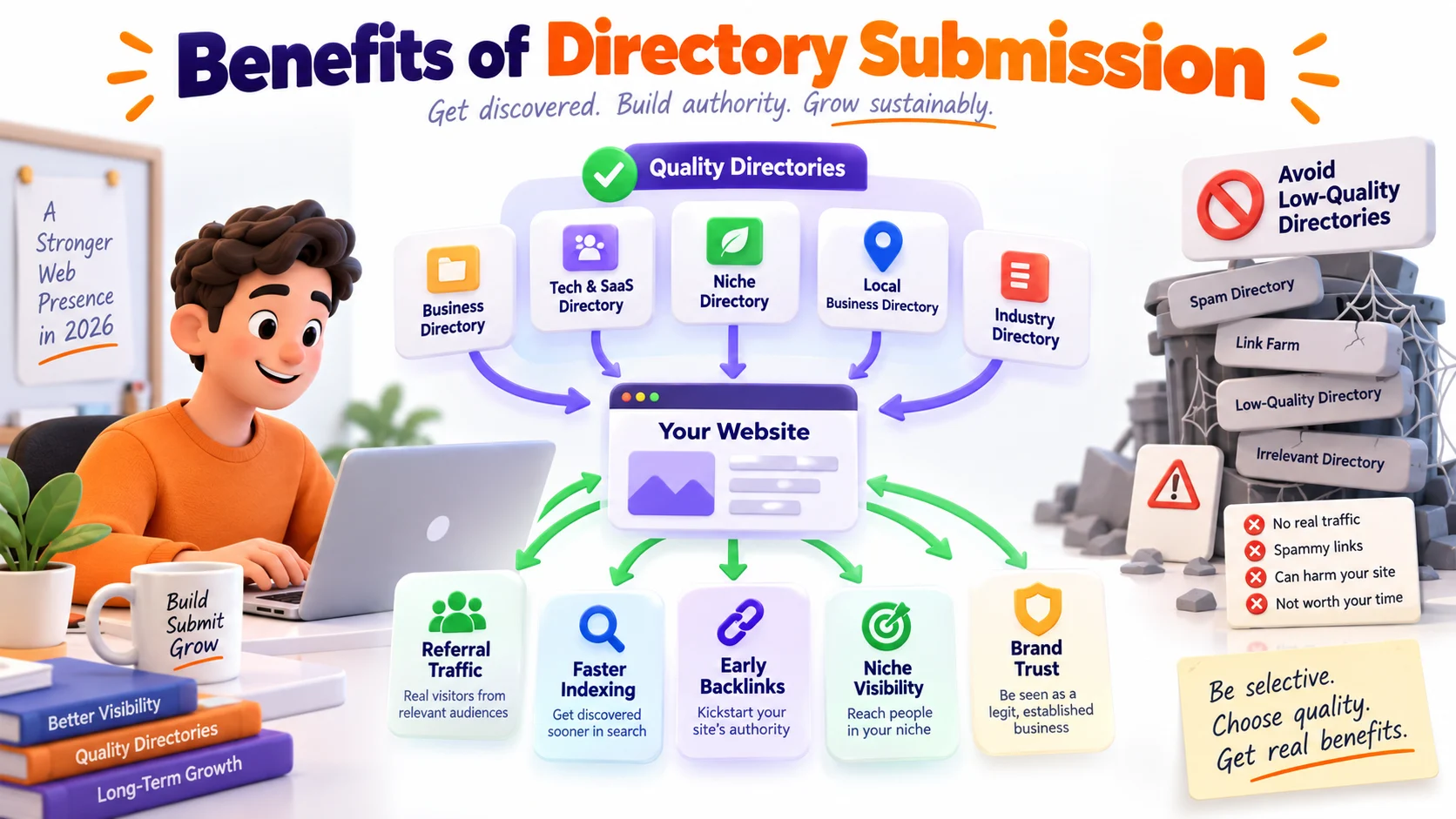
Top Benefits of Directory Submission
1. Referral traffic from people actually looking
Good directories are browsed by people actively searching for tools, services, or businesses like yours. A listing on a relevant directory can send real visitors to your site, not just create a hidden link somewhere nobody sees.
2. Early backlinks for new websites
Brand-new websites often struggle to get their first backlinks because nobody knows they exist yet. Directory submissions help solve this cold-start problem by giving new sites a handful of legitimate, accessible links early.
3. Improved local and niche visibility
For local businesses, directories like Google Business Profile, Yelp, and regional listings can directly affect local discovery. For SaaS and startups, niche directories put your product in front of a more specific audience that is already comparing options.
4. Faster indexing for new sites
Search engines discover new pages by following links. A few quality directory listings early on can help crawlers find your website faster than waiting for organic discovery alone. This is especially useful when your site is new and has no existing mentions.
5. Brand consistency and trust signals
Having your business name, description, and URL appear consistently across reputable directories creates a small but useful trust signal. It also helps users who cross-check your startup before trying it.
6. Competitive research opportunities
Browsing directories in your niche shows who else is active in your space, which categories competitors choose, how they position themselves, and what kind of screenshots or descriptions stand out.
7. Low-cost, low-effort marketing channel
Compared with paid ads or large content campaigns, directory submission is relatively low cost and does not require ongoing campaign management once the listing is live. For early-stage founders with limited time and budget, it can be one of the more efficient foundation channels.
The Catch: Not All Directories Are Worth It
The benefits above apply only to quality directories: directories with real traffic, editorial review, topical relevance, and enough trust to make the listing meaningful.
Submitting to hundreds of low-quality, auto-approve directories does little for SEO and can make your backlink profile look unnatural. That is the difference between useful directory submission and old-school spam submission.
Search Engine Journal makes a similar point in its overview of directory submissions: the value depends heavily on directory quality, relevance, and whether the listing is useful beyond just creating a link.
This is the gap a [manual directory submission service like SubmitWell](/) is built around. The goal is not to mass-submit to every directory that exists. The goal is to get founders listed in directories that are actually relevant and worth the placement.
For deeper context, read Does Directory Submission Still Work for SEO in 2026? and Top 10 Types of Backlinks.
Quality Directories vs Low-Quality Directories
Use this comparison before deciding whether a directory is worth your time.
| Factor | Quality directory | Low-quality directory |
|---|---|---|
| Editorial review | Has approval criteria or moderation | Auto-approves almost anything |
| Referral traffic | Can send meaningful visitors | Minimal to none |
| Relevance | Matches your niche, category, or buyer intent | Generic or unrelated |
| SEO impact | Can support discovery and authority | Often neutral or potentially harmful |
| Domain quality | Established, indexed, and maintained | Weak, spammy, or abandoned |
| Time to get listed | Often days to weeks | Usually instant |
| Listing quality | Detailed profiles, categories, logos, and screenshots | Thin pages with many outbound links |
Pros and Cons of Directory Submission
Pros
- Fast, low-cost way to build initial visibility
- Can drive direct, intent-based referral traffic
- Helps new sites get discovered and indexed faster
- Builds cross-platform brand consistency
- Creates early backlink and mention signals before your brand is known
Cons
- Low-quality directories waste time and add little value
- Some directories charge fees with unclear ROI
- Overdoing it can create an unnatural-looking backlink profile
- Requires research to find directories worth submitting to
- Directory submission does not replace technical SEO, content, product quality, or real customer trust
Real-World Example
A founder launching a new SaaS product might submit to five or six well-known, relevant directories in the first month, using a mix of general startup directories and niche directories specific to the product's category.
Within a few weeks, they may see a small amount of referral traffic from directory visitors, a handful of legitimate backlinks, and faster indexing of core pages. None of that replaces a full SEO strategy, but it gives the site a cleaner starting foundation.
From there, the founder can add content, product pages, comparison pages, and stronger backlinks over time. Directory submission is the foundation layer, not the whole building.
Who Benefits Most From Directory Submission?
Directory submission is most useful for:
- New SaaS products with few or no backlinks
- AI tools trying to appear in discovery lists
- Local businesses that need location-based visibility
- Indie products that need early referral traffic
- Developer tools and no-code tools competing in crowded categories
- New websites that need faster crawling and indexing
It is less useful for established brands that already have strong authority, press mentions, and organic backlinks. Those sites may still use directories selectively, but the impact is usually smaller than it is for a new website.
Should You Do It Yourself or Use a Service?
You can do directory submission yourself if you have time to research directories, create accounts, adapt descriptions, upload assets, and track live listings.
The challenge is that the work is repetitive and easy to abandon halfway. A manual, done-for-you service can save time by focusing on directories that are actually worth the placement and delivering submitted links with screenshot proof.
The right choice depends on your budget and time. If you want the detailed comparison, read Submit Manually or Use a Service?.
Get the real benefits without the low-quality directory noise
SubmitWell manually submits your startup to relevant directories, helping you build early visibility, referral paths, and backlink signals without chasing spammy directory lists.
See Plans - Starting at $35Frequently Asked Questions
Does directory submission still help SEO in 2026?
Yes, but only through quality, relevant directories. Low-quality, auto-approve directories offer little to no SEO benefit and can make a backlink profile look weak.
How many directories should I submit my website to?
There is no fixed number. A smaller list of relevant, high-quality directories is more valuable than a long list of generic directories.
Is directory submission free?
Many directories are free to submit to. Some premium or higher-authority directories charge a listing or review fee.
How long does it take to get approved on a directory?
It varies. Some directories approve instantly, while curated directories with editorial review can take days or weeks.
Can too many directory submissions hurt my SEO?
Submitting to many low-quality directories in a short period can look unnatural. Quality, relevance, and pacing matter more than raw submission count.
Are niche directories better than general business directories?
Often yes. Niche directories usually put you in front of a more relevant, higher-intent audience, especially for SaaS, AI tools, developer tools, and local businesses.
Should I do directory submission myself or use a service?
It depends on your time and research bandwidth. A manual service can save time by focusing on relevant directories and handling the repetitive submission work.
Does directory submission help with local SEO?
Yes, especially when the directory is local-specific, trusted, and consistent with your business name, address, website, and category.
Useful tools for this guide
Get the real benefits without the low-quality directory noise
SubmitWell manually submits your startup to relevant directories, helping you build early visibility, referral paths, and backlink signals without chasing spammy directory lists.
See Plans & PricingOne-time payment. No subscription.