
Top 10 Types of Backlinks: Which Ones Actually Help SEO?
If you have spent any time reading about SEO, you have heard that backlinks matter. But not all backlinks are created equal. Some can push your site up the rankings. Others do almost nothing. A few can even create risk if they look manipulative. This guide breaks down the ten main types of backlinks, what each one is worth, and how to tell the useful links from the risky ones.
In this guide
- 1.Why Backlink Type Matters More Than Backlink Count
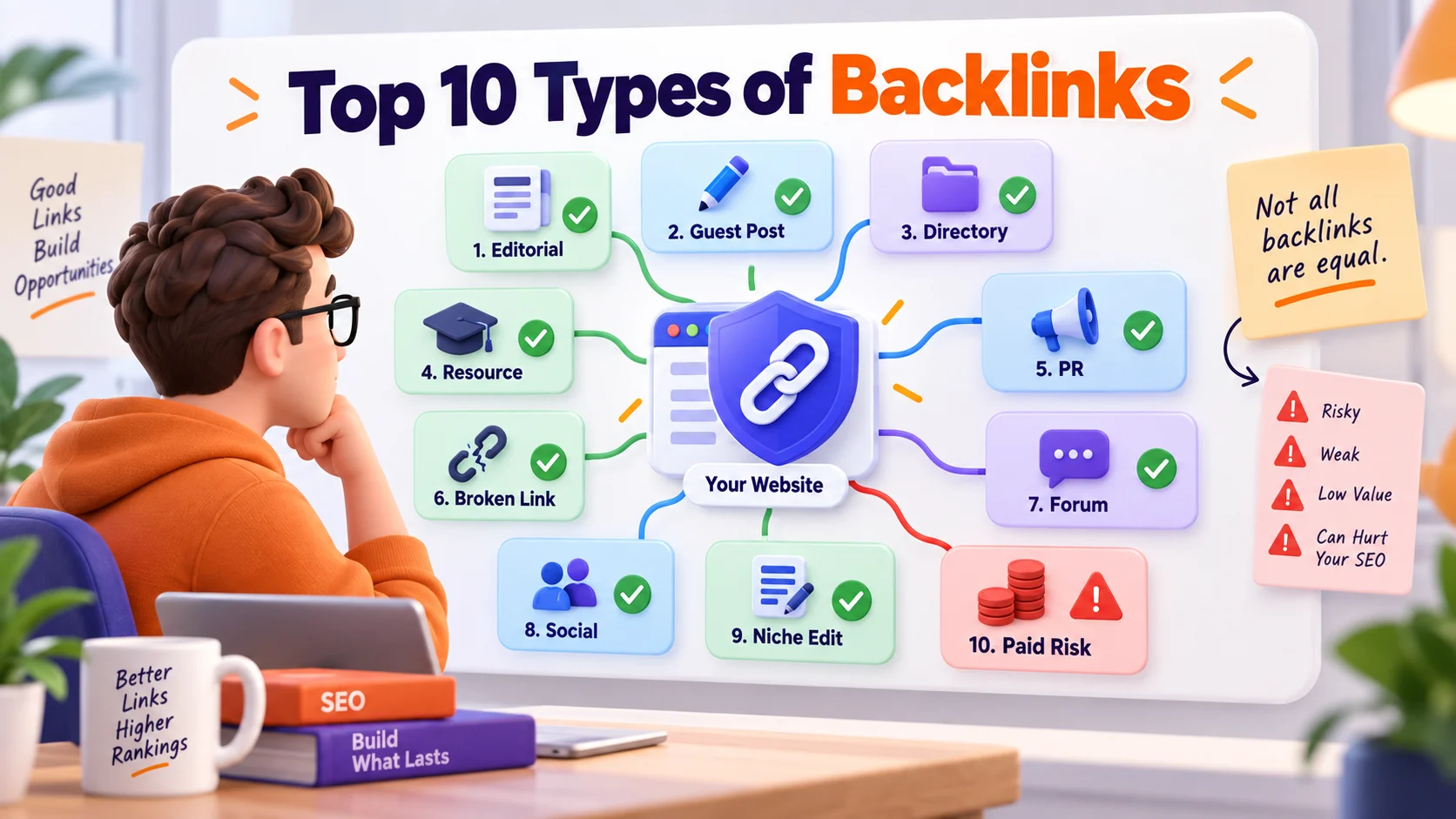
- 2.The Top 10 Types of Backlinks
- 3.Backlink Types Compared
- 4.Pros and Cons of a Diverse Backlink Profile
- 5.A Practical First 90-Day Backlink Mix
- 6.Which Backlinks Should Startups Prioritize?
Why Backlink Type Matters More Than Backlink Count
Google does not simply count how many links point to your site. It looks at where those links come from, how they were placed, whether the page is relevant, and whether the link pattern looks natural.
A single link from a respected industry blog can outweigh dozens of links from weak directories, expired domains, or link farms. That is why backlink type is not just an SEO technicality. It is the difference between building real authority and chasing numbers that do not move rankings.
For new websites, the goal is not to get every possible type of backlink immediately. The goal is to build a natural foundation: relevant directory listings, a few resource or guest post opportunities, useful content that can earn editorial links later, and no obvious paid-link footprint. For a broader launch plan, see How to Build High-Quality Backlinks for a New Website and New Website SEO Tips.
The Top 10 Types of Backlinks
1. Editorial backlinks
Editorial backlinks are links other websites add on their own because your content is genuinely useful. A journalist cites your research. A blogger links to your guide. A founder references your checklist. No payment, no forced exchange, no artificial placement.
These are usually the gold standard because they signal real trust. They are also the hardest to earn, because you need content or data worth referencing.
2. Guest post backlinks
Guest post backlinks come from articles you write for another website. The link may appear in the author bio or inside the article body.
Guest posting can still work when the site is relevant, the article is genuinely useful, and the link fits naturally. It becomes risky when the post exists only to place a keyword-rich link on a low-quality site.
3. Niche edit backlinks
Niche edits, also called link insertions or curated links, are links added into an already-published article.
They can be useful because the page may already have age, traffic, and authority. They can also be abused. If a site inserts paid links for anyone, that pattern can become risky over time.
4. Resource page backlinks
Resource pages list useful tools, guides, services, or references in a specific niche. Getting listed on a good resource page can be valuable because the page is evergreen and topically relevant.
The challenge is finding resource pages that are still maintained. Many old resource pages are abandoned, low-traffic, or overloaded with outdated links.
5. Directory backlinks
Directory backlinks come from business, startup, SaaS, product, or niche directories where you submit your website with a description and link.
Good directory backlinks can help early-stage websites because they create first trust signals, referral paths, and brand mentions. Weak directories with no curation add little value. This is why SubmitWell focuses on manual submissions to relevant directories, not automated blasts to every site that accepts a form. Read Does Directory Submission Still Work for SEO in 2026? for the detailed view.
6. Forum and community backlinks
These are links from Reddit, Indie Hackers, forums, Slack communities, Discord groups, and other discussion spaces.
Most are nofollow and should not be treated as core ranking links. Their real value is discovery: useful answers can send referral traffic, build brand familiarity, and sometimes lead to natural links later.
7. Social media backlinks
Links from X/Twitter, LinkedIn, Facebook, and similar platforms are usually nofollow and do not pass direct ranking authority in the classic sense.
Their value is indirect. If more people see your article, tool, or case study, more people may reference it from their own websites later.
8. Broken link building backlinks
Broken link building means finding a dead link on another website, then suggesting your similar live page as a replacement.
This is hard and response rates can be low, but the pitch is useful because you are helping the site owner fix a real issue. The links you win can be high quality when the page is relevant.
9. Press and PR backlinks
Press links come from news sites, industry publications, newsletters, launch coverage, or stories about your company.
These links can be very powerful because media sites often have authority and reach. The downside is that they usually require a real story: launch traction, original data, funding, a strong founder angle, or something genuinely newsworthy.
10. Paid backlinks
Paid backlinks are links purchased directly for SEO value, often inside existing posts or sponsored placements.
This is the riskiest category when the link passes ranking value without a proper sponsored or nofollow attribute. Google treats unmarked paid links as a guideline violation. Sponsorships and ads can be fine, but they should be disclosed and tagged correctly.
Backlink Types Compared
Here is a quick comparison of backlink types by SEO value, difficulty, and risk.
| Backlink type | SEO value | Difficulty to get | Risk level |
|---|---|---|---|
| Editorial | Very high | Hard | Very low |
| Guest post | High | Medium | Low when relevant |
| Niche edit | Medium to high | Medium | Medium |
| Resource page | High | Medium | Low |
| Directory | Medium | Easy to medium | Low when curated |
| Forum or community | Low direct value | Easy | Low if helpful |
| Social media | Low direct value | Easy | Very low |
| Broken link building | High | Hard | Very low |
| Press or PR | Very high | Hard | Very low |
| Paid | Varies | Easy | High if untagged |
Pros and Cons of a Diverse Backlink Profile
Pros
- Signals natural, organic growth to search engines
- Reduces reliance on a single link source
- Combines quick wins, like curated directories, with long-term authority builders, like editorial and PR links
- Creates more brand discovery points across search, communities, AI tools, and niche sites
Cons
- Easy to waste time chasing low-value links
- Paid or manipulative links can create penalty risk
- Quality directories, resource pages, and guest post opportunities take research
- Link building without strong content gives people little reason to reference your site naturally
A Practical First 90-Day Backlink Mix
A SaaS founder launching a new tool might combine several backlink types in the first 90 days.
In month one, they submit to curated startup and SaaS directories for early visibility and first backlinks. In month two, they write one or two guest posts for relevant industry blogs. In month three, they pitch a few resource pages and publish a useful guide that can earn editorial links over time.
None of these alone will usually transform rankings overnight. Together, they create a backlink foundation that looks more natural than relying on one tactic. For founders who do not want to spend weeks on directory research and forms, Submit Manually or Use a Service? explains the tradeoff between DIY and done-for-you directory submissions.
Which Backlinks Should Startups Prioritize?
For most early-stage startups, the best order is practical:
Start with safe foundation links - curated directories, product launch sites, founder communities, and relevant profiles. These are accessible before anyone knows your brand.
Build link-worthy assets - original comparisons, data, tools, calculators, templates, or deeply useful guides. These create reasons for editorial links later.
Add relevant guest posts or resource pages - focus on topical fit, not just domain rating.
Avoid shortcuts that create obvious risk - bulk paid links, irrelevant niche edits, spam directories, and repeated exact-match anchor text.
The safest backlink profile is not the one with the highest raw number. It is the one that looks like real people, real communities, and real websites are discovering and referencing your product for sensible reasons.
Build safer backlink foundations first
SubmitWell helps founders earn early discovery signals through manual submissions to relevant directories, so your backlink profile starts with practical, lower-risk links instead of spammy shortcuts.
See Plans - Starting at $35Frequently Asked Questions
Which type of backlink is best for SEO?
Editorial backlinks are usually the strongest because they are earned naturally and reflect real trust from another site. Press links and highly relevant resource page links can also be very powerful.
Are directory backlinks still worth it in 2026?
Yes, but only when they come from reputable, curated, relevant directories. Low-quality directories with no review standards add little value and can make a backlink profile look weaker.
Do nofollow links help SEO at all?
Nofollow links usually do not pass direct ranking authority like traditional followed links, but they can still drive referral traffic, improve discovery, and lead to natural backlinks later.
How many backlinks does a new website need?
There is no fixed number. Quality, relevance, and link diversity matter more than raw count. A few strong, relevant links can outperform hundreds of weak ones.
Can paid backlinks get my site penalized?
Yes. If paid links are created to pass ranking value and are not properly tagged as sponsored or nofollow, they can violate Google guidelines and create ranking risk.
What is the difference between a guest post and a niche edit?
A guest post is a new article written for another website. A niche edit is a link inserted into content that already exists on another website.
How do I find resource pages to get listed on?
Search for phrases like "[your niche] resources", "[your niche] useful links", or "[your niche] tools", then review whether the page is maintained, relevant, and selective.
Is broken link building still effective?
Yes, but it is time-consuming and response rates are usually low. It works best when your replacement page genuinely matches the dead resource and helps the site owner improve their page.
Useful tools for this guide
Build safer backlink foundations first
SubmitWell helps founders earn early discovery signals through manual submissions to relevant directories, so your backlink profile starts with practical, lower-risk links instead of spammy shortcuts.
See Plans & PricingOne-time payment. No subscription.