
Best Free AI Tool Directories to Submit Your AI Startup (2026)
By the SubmitWell Team | Updated October 2026
You built an AI tool. It works. Now nobody knows it exists. This is the most common problem we see with new AI startups. The product is ready, but the people who need it cannot find it. Free AI tool directories are one of the fastest and cheapest ways to fix that. They give you a public listing, a backlink to your site, and a small stream of early visitors. But not every directory is worth your time. Some are well known and trusted. Others are empty pages that nobody visits. This guide shows you which free directories are worth submitting to, how to prepare, and how to avoid wasting hours on the wrong ones.
In this guide
- 1.Key Takeaways
- 2.Why AI Startups Should Use Directories
- 3.How We Chose These Directories
- 4.Quick Comparison Table
- 5.Part 1: Free AI Tool Directories
- 6.Popular Directories That Need a Budget or Recheck
- 7.Part 2: Startup Launch Platforms
- 8.Part 3: Software Review and Alternative Sites
- 9.Part 4: Developer and Open-Source Places
- 10.Before You Submit: A Simple Checklist
- 11.Pros and Cons of Free Directory Submissions
- 12.Common Mistakes to Avoid
- 13.An Example Plan for Your First 30 Days
- 14.Free Submissions vs. Done-for-You Help
- 15.How to Measure If It Is Working
- 16.Frequently Asked Questions
- 17.Final Thoughts
Key Takeaways
- Free directories will not make you famous overnight. They build a base: backlinks, brand mentions, and a few early users.
- Start with 15 to 25 good directories instead of 200 weak ones.
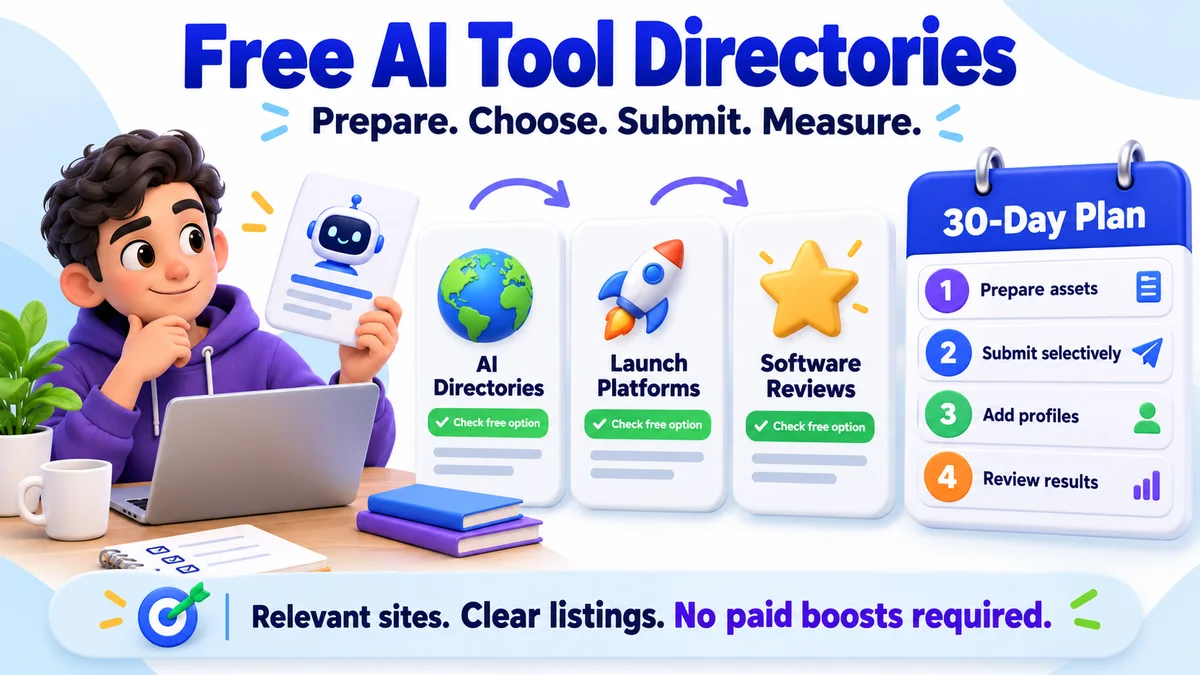
- Mix three types: AI-specific directories, startup launch platforms, and software review sites.
- Prepare one clean set of assets (logo, screenshots, short and long descriptions) before you submit anywhere.
- Terms change often. Many "free" directories also sell paid boosts, so check each site's current rules before you submit.
Why AI Startups Should Use Directories
There are three simple reasons.
1. Backlinks. A link from a trusted site tells search engines your site is real. For a brand-new domain, this matters a lot. Our guide on how to increase domain rating fast explains why a few clean links beat hundreds of spammy ones.
2. Discovery. People search for "best AI tool for [task]" every day. Directories are built to answer that search. If you are listed in the right category, you can show up in front of people who are ready to try something new.
3. Trust signals. AI search tools and Google both look at where your brand is mentioned online. A consistent profile across many reputable sites makes your startup easier to find and easier to trust.
One honest warning: most AI directories send very little traffic by themselves. Think of them as a foundation, not a marketing plan. The real value comes from the combined effect of links, mentions, and a few early users.
How We Chose These Directories
We looked at five things:
- Free option: A basic submission route is publicly offered without payment; publication still depends on review.
- Real audience: People actually browse the site.
- Clear submission process: The site explains how to submit and what editorial review requires.
- Reputation: The site is known in the founder or AI community.
- Fit: It suits AI tools, SaaS products, or early-stage startups.
Availability checked October 31, 2026. These are screening criteria, not verified traffic estimates or a ranking of audience size. The free routes below are separate from paid and unverified options. Always read the linked submission page before you start.
Quick Comparison Table
| Directory type | Best for | Typical effort | Main benefit |
|---|---|---|---|
| AI-specific directories | Any AI tool or agent | Low (10 to 20 minutes each) | Category traffic and backlinks |
| Startup launch platforms | New products and launches | Medium (needs a launch plan) | Early users and feedback |
| Software review and alternative sites | SaaS and business tools | Medium | Buyers comparing tools |
| Developer and open-source places | Models, APIs, and dev tools | Medium | Technical audience and credibility |
Part 1: Free AI Tool Directories
These sites publicly offer a free submission route for AI products or relevant software. Some serve a small, focused audience rather than a large general catalog. Listing approval is not guaranteed.
| Directory | Best fit | Free route | Good to know |
|---|---|---|---|
| TAIFY | AI tools by task | Free basic listing request | Editorial review; optional paid promotion is separate |
| There Is An AI Tool | AI tools with clear pricing and use cases | Free submission request | No guaranteed listing or sponsored placement |
| The Tool Directory | AI products, SaaS, and online utilities | Free standard listing request | Every submission is reviewed before publication |
| The AI Till | AI tools for small businesses and trades | Free editorial submission | Needs published pricing, a working site, and a suitable non-developer audience |
Our tip: Pick the right category and sub-category on each site. A tool placed in the wrong spot gets almost no views, even on a big directory.
Popular Directories That Need a Budget or Recheck
Do not treat every well-known AI directory as a free submission site. These entries from the original shortlist need different handling in a zero-budget plan.
| Directory | Current submission check | Zero-budget decision |
|---|---|---|
| There’s An AI For That | A standard free submission route could not be verified | Recheck its official submission page before including it |
| Futurepedia | A standard free tool-submission route could not be verified | Do not confuse free browsing or onboarding with free tool listing |
| Toolify.ai | The public submission form shows $99 | Skip for a zero-budget plan |
| TopAI.tools | The public page shows paid Fast Track and Featured options | No standard free submission route verified; skip unless terms change |
| RankBidr | Paid product listings start at $2; higher bids influence leaderboard placement | Optional paid discovery; exclude from a zero-budget plan |
| AI Tool Hunt | The former directory domain redirects to an unrelated site | Removed from the submission shortlist; no submission link recommended |
| BetaList | Official FAQ states all submissions require payment | Skip for a zero-budget plan |
Checked October 31, 2026. Prices and eligibility can change; use the official links to recheck. A free account or a free-to-use AI tool does not automatically mean free directory submission.
Part 2: Startup Launch Platforms
These sites are not only for AI. They are for new products. That is actually a plus, because founders, early adopters, and journalists browse them.
- Product Hunt: The best-known launch site. A launch is free, but it needs a plan. Prepare your page, your first comment, and a few friends who can give honest feedback. Do not launch with nothing ready.
- BuiltByMe: An indie-maker launch directory with a free option, limited weekly slots, and a permanent listing. Free launches receive a nofollow link; paid plans are optional.
- BetaList now requires payment, so exclude it from a zero-budget plan. See its current submission policy and the paid/unverified comparison above.
- Uneed: A launch platform for indie hackers and bootstrapped founders. Its free queue assigns your launch date; paid options let you launch sooner. Its pricing page also describes upvote thresholds for staying published and earning a followed link.
- IndieLaunch: A weekly launch platform with a free queue after you add and verify its badge on your site. Free slots are limited, and a followed link depends on the weekly ranking rather than being automatic.
- DevHunt: Made for developer tools. If your AI product is an API, SDK, or coding helper, this is a good fit.
- Peerlist: A community where makers share projects. Good for building a founder profile as well as a product listing.
- Indie Hackers: A community and product directory. You can list your product and also share your story in the forum, as long as you follow the community rules and avoid pure promotion.
- Hacker News (Show HN): Not a directory, but a place to share a product you built. It works best for technical or open-source projects. Be ready for blunt feedback.
Part 3: Software Review and Alternative Sites
These sites attract people who are comparing tools and ready to choose one. If your AI product is a business tool, they matter.
- AlternativeTo: Lets people find alternatives to well-known software. Free to list. A great spot if your tool can be pitched as "an alternative to X."
- SaaSHub: A software directory and alternatives site. Free listings are usually available.
- SaaSHunt: A SaaS launch directory with a free launch option after badge verification. Free daily slots are limited, and its pricing page ties followed links to badge verification and a top-three finish. Paid plans are optional.
- G2: A major software review site. Creating a basic product profile is typically free, but reviews take real customers.
- Capterra: A large software marketplace. Check current vendor eligibility and basic listing terms before you submit; paid lead-generation options are separate.
- Crunchbase: Not a tool directory, but a company profile here helps investors, press, and search engines recognize your startup as real.
Part 4: Developer and Open-Source Places
If you built a model, dataset, or open-source project, add these to your list.
- Hugging Face: You can share models, datasets, and demo apps (Spaces). A good fit for research and open-source AI.
- GitHub "awesome" lists: Many communities keep lists of tools by topic. You can add your project through a pull request if it fits the rules. Read the contribution guide first, and only submit if your tool really belongs.
These places build credibility with technical users. They do not work for every product, so only use them if they fit.
Before You Submit: A Simple Checklist
Submitting without preparation is the biggest time-waster. Spend one hour on this first.
- Product name and tagline: Keep the tagline under 10 words.
- Short description: About 50 words. Say what it does and who it is for.
- Long description: About 150 to 250 words. Include main features and use cases.
- Logo and screenshots: Use clean, high-quality images in the sizes most sites ask for.
- Category and tags: Choose the best fit, not the most popular one.
- Pricing info: Be honest. Free, freemium, and paid tools are all listed differently.
- Business email: Use one email address that you check often.
- Tracking sheet: List every directory, the date you submitted, the status, and the live link.
If you want a deeper look at this step, read our guide on how to prepare your startup for directory submission.
Pros and Cons of Free Directory Submissions
| Pros | Cons |
|---|---|
| No cost to start | Takes real time, often 10 to 20 minutes per site |
| Builds backlinks and brand mentions | Many sites send little traffic |
| Good for new websites with no links | Approval can be slow or never happen |
| Helps people find you in category searches | Links may be nofollow; ranking benefits are not assured |
| Easy to start with a simple plan | Low-quality directories can waste your effort |
Common Mistakes to Avoid
- Submitting to everything. More is not better. A listing on a dead site helps no one.
- Using the same text everywhere. Copy-pasting one description can look lazy and may reduce value. Make small changes for each site.
- Picking the wrong category. This is the top reason good tools get ignored.
- Ignoring the rules. Many sites reject tools with missing info, broken links, or fake claims.
- Never checking back. Some listings are rejected quietly. Track every one.
- Using spammy or paid-link directories. If a site promises hundreds of fast links for a tiny price, be careful. Our post on content SEO and clean link building explains why quality wins.
An Example Plan for Your First 30 Days
Here is a simple example of how a small AI startup could use this list. This is a sample plan, not a case study.
Imagine a two-person team that builds an AI tool for summarizing legal documents.
- Week 1: Build the asset pack (logo, screenshots, short and long descriptions). Set up the tracking sheet.
- Week 2: Submit to three to five verified free AI or software directories that fit the product, choosing the legal or productivity category where available.
- Week 3: Submit to two or three software review sites and set up a Crunchbase profile. Prepare the Product Hunt launch page.
- Week 4: Launch on one startup platform, reply to every comment, and check which listings went live.
By the end of the month, the team can have a record of around 10 to 15 submissions and any listings approved so far. Publication, backlinks, and traffic are not guaranteed within 30 days. The zero-spend plan skips paid and unverified entries.
Free Submissions vs. Done-for-You Help
Doing it yourself is a good choice if you have more time than money. But it adds up. Filling forms, solving captchas, writing small variations, and tracking results can take many hours.
If your time is tight, a manual service can take over the busywork. SubmitWell, for example, submits startups to directories by hand and gives you a report, so you can focus on building your product. If you are comparing options, read our guide to AI directory submission services for AI tool founders, and our article on submitting manually vs. using a service.
A good rule: start with the free list above for the top five to ten sites. Then decide if you want help with the rest.
How to Measure If It Is Working
Track these four things each month:
- Live listings: How many approved and published.
- Referral traffic: Visits from each directory in your analytics.
- Backlinks: New links to your site, checked in a tool like Google Search Console or a backlink checker.
- Sign-ups: How many visitors from directories start a trial or create an account.
Drop the directories that give you nothing after a few months. Put that effort into the ones that work.
Frequently Asked Questions
Are free AI tool directories really worth it?
Yes, if you pick carefully. They cost nothing but time, and they give you backlinks, brand mentions, and a small number of early visitors. Do not expect big traffic from them alone.
How many directories should I submit to?
Start with 15 to 25 good ones. Quality matters more than quantity. You can add more later once you see which ones bring visitors.
How long does it take to get approved?
It varies. Some sites publish within a day or two. Others take weeks, and some never reply. Keep a tracking sheet and check back after two to three weeks.
Will directory links improve my Google rankings?
They can help, mainly for a new site with few links. But the effect is not instant, and low-quality links will not help. Focus on trusted sites and combine this work with good content.
What is the difference between dofollow and nofollow links?
A regular followed link does not carry a nofollow qualifier. A nofollow link asks search engines not to associate the linking site with the destination in the same way; its ranking effect should not be assumed. Both can still bring human visitors. See Google’s link qualification guidance.
Should I use the same description on every directory?
No. Use the same facts, but change the wording a little for each site. This avoids duplicate text and lets you tailor your message to each audience.
Can I submit to all of them in one day?
You can, but spacing the work over a few weeks gives you time to fix mistakes and learn from the first few listings. There is no need to space submissions merely to make links look natural to search engines.
Should I do it myself or hire a service?
If you have time, do the top few yourself. If you are busy or launching soon, a manual submission service can save many hours. Avoid any service that uses bots or promises hundreds of links overnight.
Final Thoughts
Getting listed on the right free directories is one of the simplest ways to give a new AI startup a start. You do not need a big budget. You need a clear plan, good assets, and a little patience.
Start small. Submit to the best AI-specific sites, add two or three launch platforms, and set up your review site profiles. Track what works, drop what does not, and keep going. Over a few months, these small steps add up to real visibility.
Need help with manual directory submissions?
SubmitWell handles manual startup directory submissions and provides submitted links and screenshot proof, so you can spend more time building your AI product.
See Plans - Starting at $35Useful tools for this guide
Related Resources
Need help with manual directory submissions?
SubmitWell handles manual startup directory submissions and provides submitted links and screenshot proof, so you can spend more time building your AI product.
See Plans & PricingOne-time payment. No subscription.