
Content SEO: A Practical Guide for Founders and Indie Hackers
If your website has good content but nobody finds it, you do not have only a content problem. You have a content SEO problem. Content SEO is the practice of creating and structuring content so search engines can understand it, trust it, and rank it for the terms your audience is actually searching for.
In this guide
- 1.What Is Content SEO?
- 2.Why Content SEO Matters More Than Ever
- 3.The Core Building Blocks of Content SEO
- 4.Content SEO vs Technical SEO vs Off-Page SEO
- 5.A Simple Content SEO Workflow for Solo Founders
- 6.Common Content SEO Mistakes
- 7.Real-World Example
What Is Content SEO?
Content SEO sits at the intersection of two things: writing content people want to read, and structuring it in a way search engines can process.
It covers:
- Keyword research - finding out what your audience actually types into Google
- Search intent matching - making sure your content answers what the searcher actually wants, whether that is a comparison, how-to, tool, or definition
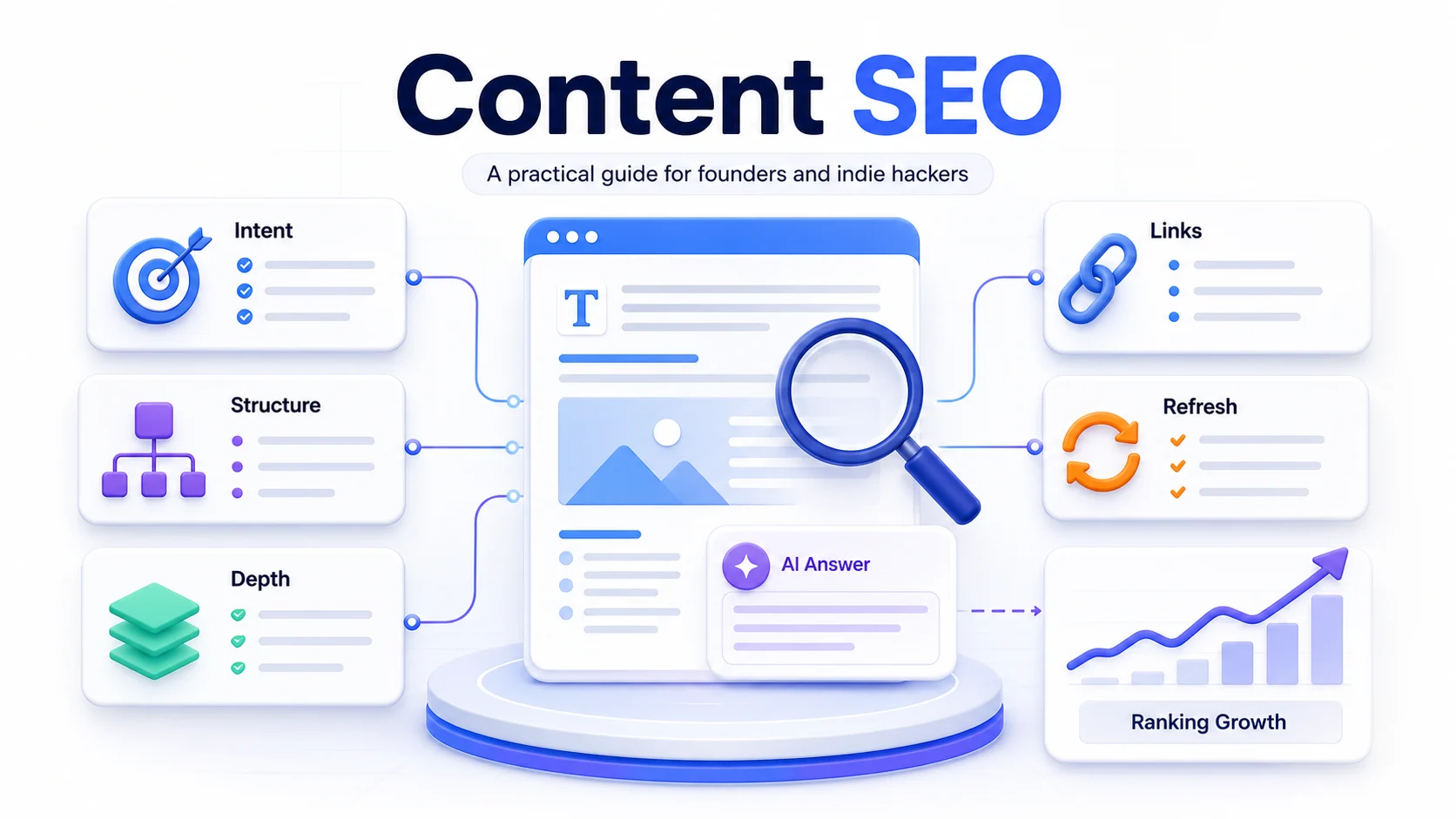
- On-page structure - headings, internal links, readability, schema markup, and metadata
- Content depth and originality - covering a topic thoroughly instead of skimming it
- Freshness and maintenance - updating old content instead of letting it rot
Content SEO is different from technical SEO, which focuses on speed, crawlability, and indexing. It is also different from off-page SEO, which focuses on backlinks, mentions, and PR.
Content SEO is about the words on the page and how they are organized, but it does not work in isolation. A brilliant article on a slow, unindexed page still will not rank.
Why Content SEO Matters More Than Ever
Search has changed. AI Overviews, AI chat assistants, and zero-click searches now answer many simple queries directly in the results page. That means thin, generic content written only to hit a keyword gets skipped over even more than before.
What still wins:
- Content that goes deeper than a surface-level answer
- Content that demonstrates real experience with screenshots, data, examples, or a clear point of view
- Content structured so both humans and AI systems can extract clear answers, sometimes called AEO
- Content that is genuinely updated, not just republished with a new date
For early-stage founders, this can be an advantage. You do not need a 50-person content team. You need fewer, better pieces that answer real questions thoroughly.
The Core Building Blocks of Content SEO
1. Keyword and intent research
Before writing anything, figure out:
- What is the searcher trying to accomplish?
- Is this a long-tail, low-competition term you can realistically rank for early on?
- What is already ranking, and what is missing from it?
A simple rule: if the top five results are all comprehensive, well-linked, high-authority pages, that is a hard keyword to break into as a new site. Long-tail, specific queries are usually your best early wins.
2. Search-intent-matched content format
Google and AI answer engines reward content that matches the format the searcher expects, not just the topic. If people searching a term mostly see listicles, a single long essay probably will not outrank them. If they see comparison tables, build one.
3. On-page structure
Use one clear H1 with the primary keyword. Build a logical H2/H3 hierarchy that could work as a standalone table of contents. Keep paragraphs short, add internal links, and use structured data where it fits.
Our free tools can help with this workflow:
4. Depth and originality
Thin content that only restates what already ranks rarely wins anymore. Original examples, real screenshots, specific data, and a genuine point of view separate content that ranks from content that gets ignored.
5. Maintenance
Content SEO is not publish and forget. Rankings decay as competitors publish newer, more complete pages. Revisiting your best-performing articles every few months with new data, better examples, and fixed links is often more effective than publishing something brand new.
Content SEO vs Technical SEO vs Off-Page SEO
Here is a simple comparison for founders.
| Aspect | Content SEO | Technical SEO | Off-Page SEO |
|---|---|---|---|
| Focus | What is on the page | How the site performs and gets crawled | Signals from outside the site |
| Examples | Keyword research, structure, depth | Site speed, indexing, Core Web Vitals | Backlinks, brand mentions, PR |
| Time to impact | Weeks to months | Days to weeks once fixed | Months, compounding over time |
| Cost to solo founders | Time-intensive, low cash cost | Often one-time fixes, sometimes dev help | Slow without outreach or a service like SubmitWell |
| Ongoing effort | High, because content needs regular updates | Low once fixed | Medium, because outreach and submissions continue |
A Simple Content SEO Workflow for Solo Founders
Use this repeatable workflow:
1. Pick one topic cluster instead of 20 random blog ideas. 2. Find 5 to 10 long-tail keywords within that cluster. 3. Check what is currently ranking and identify the gap. 4. Write one genuinely thorough piece that fills that gap. 5. Add structure: headings, FAQ, internal links, schema, title, and meta description. 6. Publish, then get it in front of real audiences through communities, directories, newsletters, and partner mentions. 7. Revisit it in 60 to 90 days and update it.
This is where off-page work matters too. Even great content needs some initial visibility. Getting listed on relevant startup directories can give new content early backlinks and referral traffic. Services like SubmitWell handle these submissions manually so listings are relevant instead of automated spam.
Common Content SEO Mistakes
Avoid these common mistakes:
- Keyword stuffing instead of natural language - search engines are much better at detecting unnatural writing now.
- Publishing volume over depth - ten thin posts rarely outperform two thorough ones.
- Ignoring search intent - ranking for a keyword does not help if the page format does not match what searchers want.
- No internal linking strategy - orphaned pages with no links in or out rarely rank well.
- Never updating old content - old winners can decay while competitors refresh theirs.
- Skipping basic metadata - weak title tags and meta descriptions can hurt click-through rate even when the page ranks.
Real-World Example
A SaaS founder writes one 2,500-word guide on "how to reduce SaaS churn" instead of five shallow 500-word posts on related mini-topics.
The guide includes:
- An original churn calculation example
- A comparison table of retention tactics
- Screenshots from the product or workflow
- An 8-question FAQ
- Internal links to related retention, onboarding, and pricing pages
- Schema markup where appropriate
Within a few months, it starts ranking for a cluster of long-tail variations like "reduce churn for B2B SaaS" and "SaaS churn rate benchmark" because it is the most complete answer available, not because it targeted the most keywords.
Give your best content an early visibility push
SubmitWell manually submits startups to curated directories, helping founders build relevant backlinks, referral traffic, and proof reports without automated spam.
See Plans - Starting at $35Frequently Asked Questions
What is content SEO in simple terms?
Content SEO is the practice of writing and structuring content so both search engines and readers can easily find, understand, and trust it.
Is content SEO different from copywriting?
Yes. Copywriting is mainly about persuasion. Content SEO is about discoverability, structure, search intent, and ranking potential. Strong content SEO often includes good copywriting, but the goals are not identical.
How long does content SEO take to show results?
For newer sites, content SEO usually takes 2 to 6 months to show meaningful results, depending on competition, domain authority, crawlability, and content quality. Long-tail keywords tend to move faster.
Do I need to publish content constantly?
No. Consistent, high-quality, well-structured content published less frequently usually beats high-volume, low-depth publishing.
What is the ideal article length for SEO?
There is no fixed ideal length. The page should be long enough to fully satisfy the search intent. A comparison guide may need 2,000 words or more, while a narrow how-to can be much shorter.
Does content SEO still matter with AI Overviews and AI search?
Yes. It matters even more because AI systems often pull from content that is clearly structured, factually accurate, and deep enough to answer the query well.
What is the easiest content SEO mistake to fix first?
Start with missing or weak title tags, meta descriptions, headings, internal links, and image alt text. These are usually quick fixes and can improve how the page is understood and clicked.
How does content SEO relate to backlinks?
Great content can earn links naturally, but newer sites often need an initial distribution push through outreach, communities, directories, partnerships, or relevant submissions.
Useful tools for this guide
Give your best content an early visibility push
SubmitWell manually submits startups to curated directories, helping founders build relevant backlinks, referral traffic, and proof reports without automated spam.
See Plans & PricingOne-time payment. No subscription.