
Google Panda Update: What It Is, Why Google Made It, and How to Use It in SEO
If you work in SEO, you may hear people say, be careful, do not get hit by Panda. At first, it sounds a little funny. Panda sounds like a cute animal, not something that can damage a website. But in SEO, Google Panda is one of the most important algorithm updates ever released.
In this guide
- 1.What Is the Google Panda Update?
- 2.Why Did Google Build Panda?
- 3.How Does Panda Work?
- 4.Panda vs Other Big Google Updates
- 5.How to Use Panda Lessons in Your SEO
- 6.A Simple Example
- 7.Pros and Cons of the Panda Update
- 8.Final Thoughts
What Is the Google Panda Update?
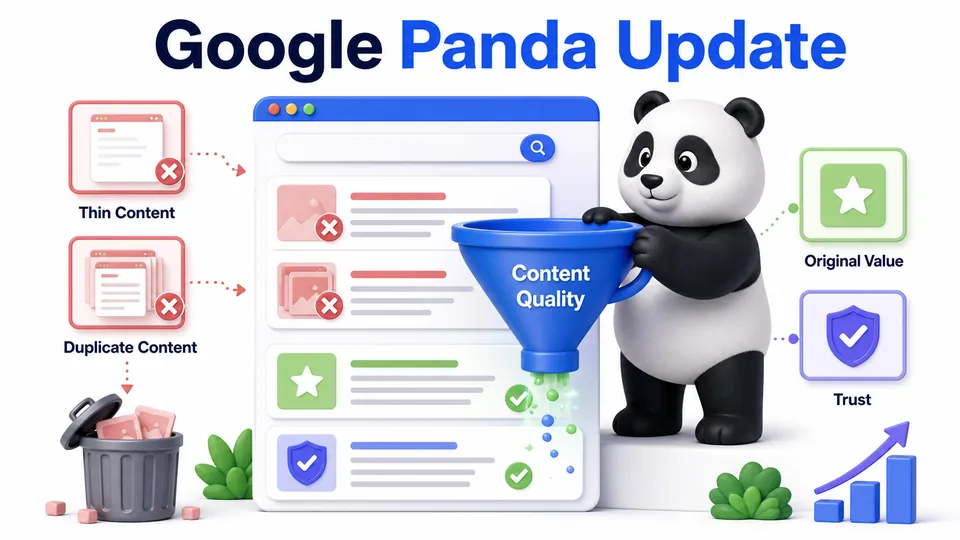
The Google Panda Update was first released in 2011. Its main purpose was to reduce the ranking of low-quality websites and reward websites with useful, original, and trustworthy content.
Before Panda, many websites were ranking well even though their content was weak. Some websites published thousands of short articles just to target keywords. Some copied content from other sites. Some pages were full of ads and gave users very little value.
Google wanted to fix this problem.
Panda helped Google identify poor-quality content and push better content higher in search results. In simple words, Panda was created to make Google search results more helpful for users.
Why Did Google Build Panda?
Google created Panda because search results were getting filled with low-quality pages.
At that time, many websites focused more on search engines than users. They created pages only to rank for keywords, not to genuinely help people.
Some common problems included:
- Thin content with very little useful information
- Duplicate content copied from other websites
- Content farms publishing large amounts of low-value articles
- Too many ads above the main content
- Poor writing quality
- Pages that did not answer the user's question
- Websites created mainly to get traffic and ad revenue
Users were clicking search results but not finding helpful answers. This hurt Google's search quality. Panda was Google's way of saying: content quality matters.
How Does Panda Work?
Google Panda looks at signals that help determine whether a website provides useful content or low-quality content.
Google does not reveal every detail, but Panda is generally connected to content quality signals such as:
- Is the content original?
- Is the page helpful?
- Does the content answer the searcher's question?
- Is the page filled with ads?
- Is the content copied or rewritten from another source?
- Would users trust this page?
- Does the website have many weak pages?
One important thing to understand is that Panda can affect the whole website, not just one page.
If a website has many low-quality pages, the overall trust of the site can go down. That is why a few good pages may not be enough if the rest of the website is filled with weak content.
Panda vs Other Big Google Updates
Here is a simple comparison.
| Update | Year | Main Problem Targeted | Focus Area |
|---|---|---|---|
| Panda | 2011 | Weak, thin, or copied content | Content quality |
| Penguin | 2012 | Spammy or fake backlinks | Link quality |
| Hummingbird | 2013 | Poor understanding of searches | Search meaning |
| RankBrain | 2015 | Unclear or new queries | Machine learning |
| BERT | 2019 | Misunderstood longer phrases | Language understanding |
| Helpful Content Update | 2022 | Content written mainly for search engines | People-first content |
Panda is mainly about content quality. Penguin is mainly about link quality. Helpful Content is closely related to Panda because both focus on whether content is genuinely useful for people.
How to Use Panda Lessons in Your SEO
Even though Panda started years ago, its lessons still matter today. If you want long-term SEO growth, you should build your website around quality, not shortcuts.
1. Check your site for thin content
Thin content means pages that do not provide enough useful information. A page with only a few lines of text usually does not help much unless it solves the user's need clearly.
Ask yourself:
- Does this page answer a real question?
- Is it useful compared to other pages ranking for the same topic?
- Can I add examples, steps, data, screenshots, or explanations?
If a page is weak, improve it or remove it. A simple SEO audit checklist can help you review these pages.
2. Remove duplicate or near-duplicate pages
Duplicate content can confuse search engines. If many pages say almost the same thing, Google may not know which one to rank.
For example:
- City pages with the same text
- Product pages with copied descriptions
- Blog posts repeating the same points
- AI-generated pages with similar wording
Instead of creating many weak pages, create fewer but stronger pages. If needed, use canonical tags or merge similar pages. You can also run an on-page SEO analysis to find weak page structure.
3. Cut down on too many ads
A page should not feel like an ad wall. If users must scroll past many ads before they see the real content, the experience is poor.
Google wants users to find answers quickly.
So keep the main content easy to read. Ads, popups, and banners should not block the value of the page.
4. Show real expertise
Panda rewards useful and trustworthy content. You can improve trust by adding:
- Real examples
- Original opinions
- Author details
- Case studies
- Screenshots
- Research
- Clear explanations
- Updated information
Do not just rewrite what every other website says. Add something useful from your own experience.
5. Improve engagement the right way
If people leave your page quickly because it does not help them, that is a bad sign.
Improve engagement by:
- Writing better introductions
- Answering the main question early
- Using headings clearly
- Adding examples
- Making pages easier to scan
- Improving page speed
- Matching search intent
Good engagement comes from helping users, not tricking them.
6. Think about your whole site, not just one page
Because Panda can look at site-wide quality, you should not only improve your best pages.
Review the whole site:
- Remove old low-value pages
- Update outdated posts
- Merge overlapping articles
- Improve weak pages
- Keep only pages that serve a clear purpose
This is especially important for startups creating many SEO pages. Programmatic SEO can work, but only when every page has real value. For a broader view, read why Google updates are important for SEO.
A Simple Example
Imagine a website called QuickAnswers.com.
It has 5,000 short articles. Most articles are only 150 words long. Many are copied from other websites. The site has ads at the top, in the middle, and at the bottom.
Before Panda, this site might rank well because it has many keyword-focused pages.
After Panda, Google may decide that the site is low quality. Traffic drops by 60 percent.
To recover, the website owner:
- Deletes the weakest 1,000 articles
- Combines similar articles
- Expands useful pages to 800 to 1,500 words
- Adds original examples
- Removes excessive ads
- Adds expert author information
- Updates old information
Over time, Google may start trusting the site again.
This is how Panda recovery works. You do not trick Panda. You improve the website.
Pros and Cons of the Panda Update
Pros
- Better search results for users
- Rewards original and useful content
- Discourages copied content
- Reduces low-quality content farms
- Encourages website owners to improve quality
Cons
- Some websites lost traffic suddenly
- Recovery can take time
- Site owners may need to remove many pages
- It can be hard to know exactly which pages are hurting the site
- Small sites with weak content can struggle
Final Thoughts
The Google Panda Update changed SEO forever. It made one thing clear: content quality is not optional.
If your website has thin, copied, or low-value content, it can hurt your SEO. But if your content is original, useful, clear, and trustworthy, Panda's lessons can work in your favor.
The best way to protect your website from Panda-like quality updates is simple:
Write for people first.
Help users solve real problems.
Remove weak pages.
Build a website that deserves to rank.
SEO is not just about keywords and backlinks. It is about trust, usefulness, and quality.
Build a cleaner SEO foundation after Panda
SubmitWell helps startups build real directory profiles, proof reports, and cleaner backlink signals that support long-term SEO instead of thin content shortcuts.
See Plans - Starting at $35Frequently Asked Questions
What is the Google Panda Update?
The Google Panda Update is a Google algorithm update launched in 2011 to reduce rankings for low-quality, thin, copied, or unhelpful content and reward websites with useful, original content.
What type of content does Panda target?
Panda targets thin content, duplicate content, copied articles, content farms, pages with too many ads, and content that does not satisfy user intent.
Can Panda affect an entire website?
Yes. Panda can affect site-wide quality. If a website has many weak pages, it can reduce the overall trust and ranking ability of the site.
Is Google Panda still important today?
Yes. Even though Panda is now part of Google's broader ranking systems, its core idea still matters: Google wants helpful, original, high-quality content.
How can I recover from a Panda-like content quality issue?
Improve weak content, remove duplicate pages, reduce excessive ads, update old posts, merge similar articles, and focus on useful, trustworthy information.
Is Panda the same as the Helpful Content Update?
No. They are different updates, but they are related in purpose. Both focus on content quality and whether pages are useful for people.
Does Panda target backlinks?
No. Panda mainly focuses on content quality. Google Penguin is the update more closely connected to spammy backlinks.
What is the biggest lesson from Google Panda?
The biggest lesson is that publishing many low-quality pages is risky. It is better to create fewer, stronger, more useful pages that genuinely help users.
Useful tools for this guide
Related Resources
Build a cleaner SEO foundation after Panda
SubmitWell helps startups build real directory profiles, proof reports, and cleaner backlink signals that support long-term SEO instead of thin content shortcuts.
See Plans & PricingOne-time payment. No subscription.