
Startup SEO Strategy: A Practical Guide for Founders With No Time to Waste
Most startup founders do not have a marketing team, a big budget, or months to wait around. What you have is limited time, a product people need, and a website that nobody has found yet. This guide lays out a startup SEO strategy built for that reality: not a 12-month enterprise plan, but a sequence you can actually execute in your first few months.
In this guide
- 1.Why Startup SEO Is Different
- 2.The Startup SEO Strategy, Step by Step
- 3.Startup SEO Priorities by Stage
- 4.Pros and Cons of a Lean Startup SEO Approach
- 5.Real-World Example
Why Startup SEO Is Different
SEO advice written for big companies assumes things most startups do not have: an existing content team, years of accumulated backlinks, or a brand people already search for by name.
A startup SEO strategy has to work around three constraints:
- Zero or near-zero domain authority - nobody links to a site nobody has heard of yet.
- No search volume for your brand name - people are not typing your company into Google yet.
- Limited hands - usually one founder or a tiny team doing SEO alongside product, support, sales, and everything else.
Because of this, startup SEO strategy is not about doing everything at once. It is about choosing the few moves that compound fastest with the least wasted effort.
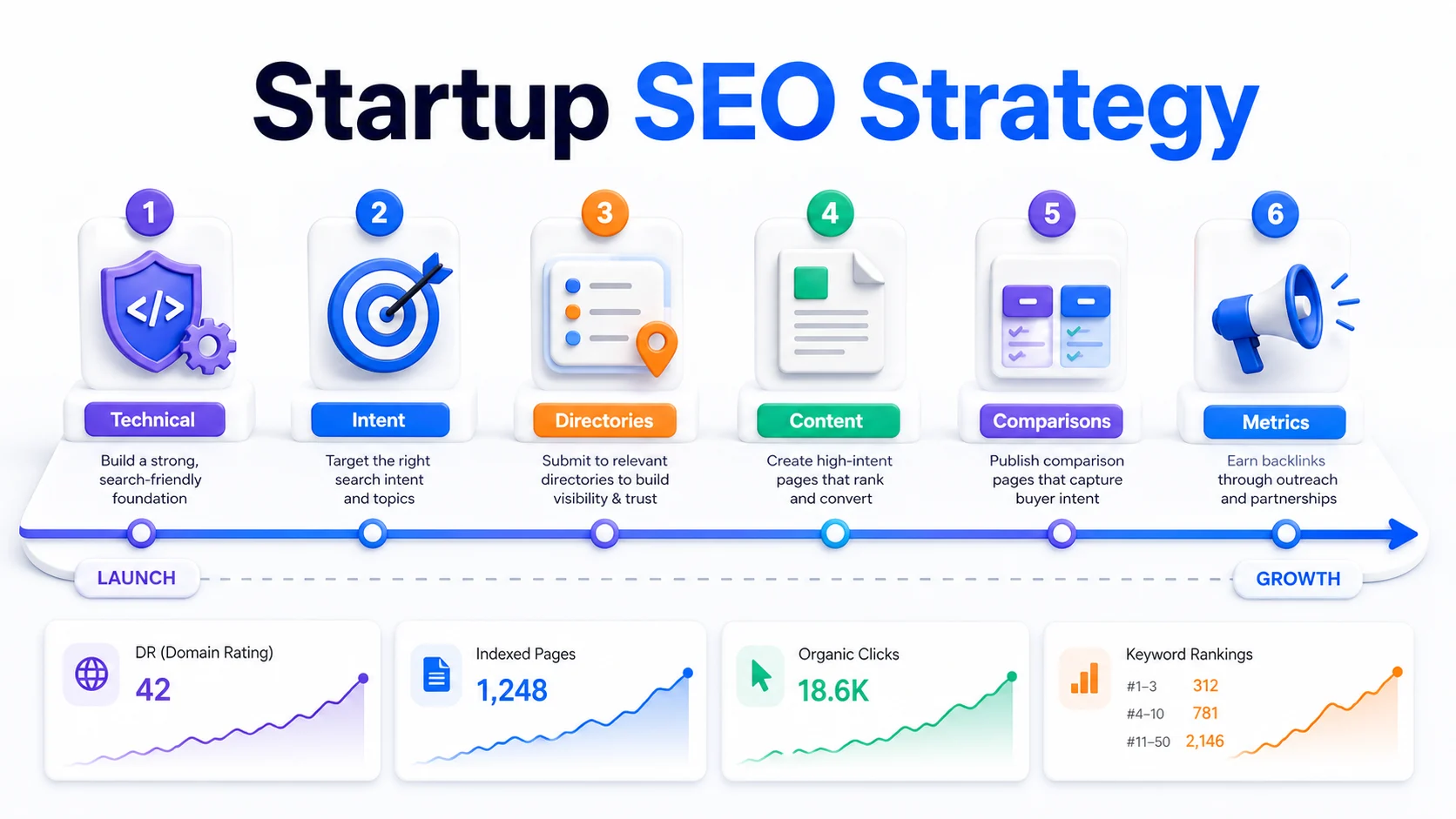
The Startup SEO Strategy, Step by Step
1. Fix the technical foundation first
Before writing a single blog post, make sure Google can actually crawl and understand your site. That means clean navigation, fast page speed, mobile-friendly design, basic schema, and an XML sitemap submitted to Google Search Console.
Use our Sitemap URL Counter, Canonical URL Checker, Meta Tag Checker, and Heading Structure Checker to catch basic issues before you scale content. For deeper context, read the Technical SEO Explained guide.
2. Nail down search intent before keywords
Founders often start by hunting for keywords with big search volume. A better approach is mapping what your ideal customer is searching for at each stage: problem-aware, solution-aware, and product-aware.
For example, a B2B SaaS tool might target:
- Informational: "how to manage remote team onboarding"
- Comparison: "[competitor] alternatives"
- Transactional: "best onboarding software for startups"
3. Build early authority with directory submissions
This is usually one of the fastest, lowest-effort ways to get your first backlinks and a bit of early referral traffic. Submitting to relevant, well-moderated startup and tool directories gets your site indexed by trustworthy sources without requiring a large content library first.
Read Does Directory Submission Still Work for SEO in 2026? and How to Choose the Right Directory Submission Service if you are comparing manual versus automated options.
4. Publish a small number of high-intent pages
Instead of publishing 50 mediocre blog posts, most startups are better off with 10 to 15 genuinely useful pages that target buyer questions. Depth beats volume when resources are limited. Our Content SEO guide explains how to structure those pages.
5. Create one or two comparison or alternative pages
"Your product vs competitor" and "competitor alternatives" pages often convert well because the searcher already knows they need a solution. They are deciding which one.
6. Start light digital PR and outreach
You do not need a PR agency. Answering journalist requests, sharing product data, publishing guest posts on a few relevant sites, and getting listed in credible directories can move both traffic and authority.
7. Track the few metrics that matter
Do not drown in dashboards early on. Watch indexed pages, organic clicks and impressions, Domain Rating trend, and rankings for your top 10 to 20 target keywords.
Startup SEO Priorities by Stage
Here is a practical sequence founders can follow.
| Stage | Focus | Typical timeline | Key actions |
|---|---|---|---|
| Pre-launch / Day 0 | Technical foundation | Week 1-2 | Site structure, speed, schema, sitemap |
| Early stage | Initial authority | Month 1-3 | Directory submissions, 5-10 core pages |
| Growth stage | Content depth | Month 3-6 | Comparison pages, guest posts, linkable assets |
| Scaling stage | Authority + volume | Month 6-12 | Digital PR, expanded content, backlink outreach |
Pros and Cons of a Lean Startup SEO Approach
Pros
- Lower cost than paid acquisition channels
- Compounds over time because early pages keep working after you publish them
- Builds a durable asset in your site authority instead of renting attention through ads
- Directory submissions and technical fixes can show early signals within weeks
Cons
- Slower than paid ads for immediate traffic
- Requires patience because meaningful organic growth usually takes 3 to 6 months or more
- Easy to spread effort too thin across too many keywords or content types
- Technical mistakes early on can quietly hold back everything built later
Real-World Example
A two-person startup building a scheduling tool launched with no backlinks and no organic traffic.
In month one, they fixed slow page load times, added schema markup, and submitted to 20 relevant directories. In month two, they published eight core pages targeting buyer-intent keywords and two competitor comparison pages.
By month four, they were getting steady organic traffic for long-tail keywords and had climbed from Domain Rating 0 to 18.
Their biggest lesson: the technical fixes and directory submissions did more for early growth than any single blog post.
Build your startup SEO foundation faster
SubmitWell helps founders handle the early authority step with manual directory submissions, relevant backlinks, and proof reports, so your SEO strategy starts with cleaner discovery signals.
See Plans - Starting at $35Frequently Asked Questions
What is the first SEO step a new startup should take?
Fix technical issues first: site speed, mobile-friendliness, crawlability, sitemap, canonical tags, and basic schema markup. Content and backlinks work better once the technical foundation is solid.
How long does startup SEO take to show results?
Most startups can see early signals like indexing and small keyword movements within 4 to 8 weeks. More meaningful organic traffic growth usually takes 3 to 6 months.
Should a startup focus on blog content or product pages first?
Product, solution, and comparison pages usually convert better and should come first. Blog content is valuable for informational keywords, but it works best as part of a broader strategy.
Is it worth hiring an SEO agency in the early stage?
Not always. Many early SEO tasks, such as technical checks, directory submissions, and core page content, can be handled without a full agency. Agencies become more useful when you are ready to scale content and outreach.
How many keywords should a startup target initially?
A realistic starting point is 10 to 20 well-chosen, high-intent keywords. Trying to target 100 or more keywords too early usually spreads effort too thin.
Do startup directories actually help SEO?
Yes, when they are relevant and moderated. They can provide early backlinks, indexing signals, and referral traffic from people browsing for tools like yours.
What is the biggest SEO mistake startups make?
Publishing large volumes of low-quality content before fixing technical issues or understanding search intent. This wastes effort and can hurt site-wide quality signals.
How is startup SEO different from SEO for an established company?
Startups must prioritize ruthlessly because they begin with limited time, low authority, and little brand demand. Established companies can spread effort across more channels because they already have traffic and backlinks.
Useful tools for this guide
Build your startup SEO foundation faster
SubmitWell helps founders handle the early authority step with manual directory submissions, relevant backlinks, and proof reports, so your SEO strategy starts with cleaner discovery signals.
See Plans & PricingOne-time payment. No subscription.